
Understanding the gap between assessments and tax bills
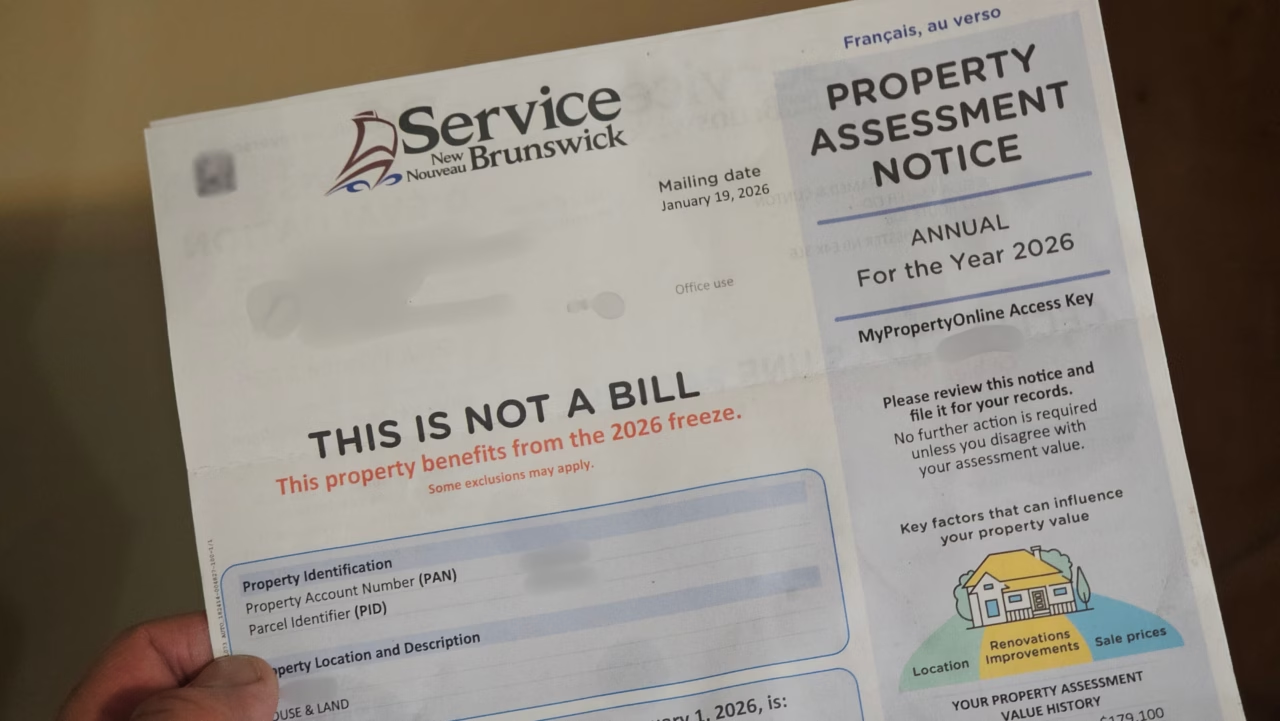
Property assessment notices went out across New Brunswick in January, but they do not show what residents will actually pay in property taxes this year.
Final tax bills are expected to arrive in March. Until then, residents are trying to understand how the province’s one-year assessment freeze and local tax rates affect households in Tantramar.
Questions playing out online
That uncertainty has also been playing out online, including on Reddit, where homeowners have been debating who qualifies for the assessment freeze, particularly new homeowners and people who recently renovated or changed how their property is used.
Hear the audio below:
Holding services steady in 2026
Michael Beal is Tantramar’s Director of Financial Services. I spoke with Beal in recent months about the municipality’s 2026 budget.
Beal says the goal was to maintain existing services.
“We are still planning for today and for the future. We have budgeted the necessary amounts within the fire department. The necessary amounts within the police department, the necessary amounts within active living and culture recreation within all departments in order to continue to provide the same services that we had in the future.”

How the assessment freeze factors in
The province introduced a one-year assessment freeze for most properties.
“The province did do an assessment freeze. The taxes are going up for some areas,” Beal said.
For many Sackville and Dorchester residents, that means no change to their final tax bill.
“If your house was worth $300,000 in 2025, it will be $300,000 in 2026,” Beal said. “Therefore, your tax bill will be the same for those in the local service districts with the assessment freeze.”
Where increases still apply
Beal says some areas will still see rate increases.
“The budget does see tax increases in the local service districts of 5 cents for Sackville and Dorchester, a little over 4 cents for Point de Bute. Local service districts and Sackville and Dorchester tax rates remain the same in 2026 as 2025.”
What five cents means
Beal says the increase equals five cents per $100 of assessed value.
“So if you have a $100,000 home, that would result in a $50 increase in property taxes. If you had a $200,000 home, it would be a $100 increase.”
Rising costs behind the budget
Beal says rising costs have made budgeting more difficult.
“So everything is increasing significantly that the municipality has to provide. But we attempt through the budget process to have as minimal effect as possible on the residents. Unfortunately, there is an effect when this happens.”
What happens next
Assessment notices show property value, not the final tax bill.
Property tax bills are expected to arrive in March. Residents who disagree with their assessment have until February 18 to request a review.

Clinton Davis is a community journalist and audio producer covering the people, events, and ideas shaping the Tantramar region.