
Hear the audio below:
Rural ‘Tantramar’: Life under the Local Service District system
In 2021, the New Brunswick government announced sweeping local governance reform. On January 1, 2023, the Municipality of Tantramar officially came into effect. With municipal elections coming up again this May, the changes remain fresh for many rural residents.
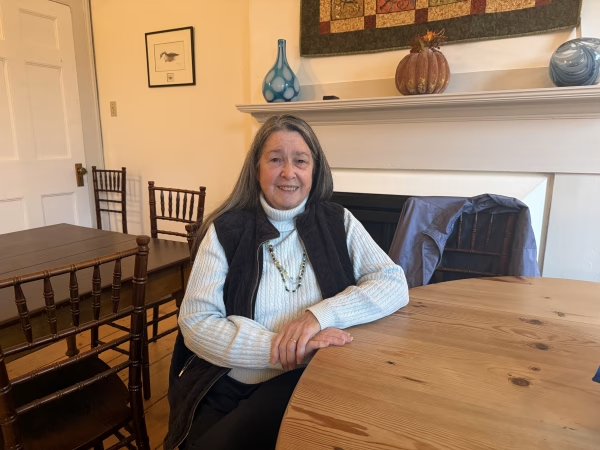
Greg Martin has seen both systems.
Martin is a Tantramar councillor, but prior to amalgamation he served for decades on his local service district committee. He was born in 1947 and raised in Lac on Greenhill Road.
Life before elected representation
Before 2023, many rural residents in New Brunswick didn’t elect a municipal councillor. They lived in what were called Local Service Districts, or LSDs. Services were delivered by the province. There was no elected council.
“We never had no vote. We never had no say,” Martin said.
He still attended meetings.
“Every time I showed up out of curiosity, somebody would say, ‘Hey, we got somebody.’ And they would point at me and say, you’re appointed to the local service district.”
But appointment did not mean empowerment. The LSD representatives had basically no authority, he said.
“It was basically in name only. We had absolutely nothing to say.”
For 30 years, Martin served under that structure. When rural residents had concerns, he says there wasn’t a clear line of accountability.
“I would remind them that us people on the local service district had absolutely no say. Anything.”
Redrawing the map
The province said reform would modernize municipal government and ensure every resident had elected representation. LSDs were dissolved. New municipalities were created.
Martin says he agreed to serve on a reform committee in those early days of the transition.
“They asked me if I’d serve on that committee. And I said absolutely. I’m one of the ones that’s been most vocal about having an elected representative.”
He recalls how the final structure felt from the local level.
“Somebody in Fredericton took a pencil and redrew the province.”
Representation at last
When Tantramar officially formed, Martin ran in Ward 5 and was acclaimed.
For him, the shift is about accountability.
“I live on Green Hill Road. If there’s a pothole on Green Hill Road, who do I go to?”
Today, that question has an answer.
Martin says the work is not finished.
“I feel that we did a lot in the last four years, but I feel there’s a lot more to do.”
With elections approaching, Tantramar voters will once again choose their representatives — something rural residents here did not have just a few years ago.

Clinton Davis is a community journalist and audio producer covering the people, events, and ideas shaping the Tantramar region.