
It has been a week since the National Day for Truth and Reconciliation. Several First Nation people who spoke with CHMA say much of what they want others to understand about their communities happens outside that annual day of attention.
Donna Augustine says that when someone dies in her community, people come to the family’s home. Someone might put on tea or coffee while another person helps around the house. A sacred fire is lit outside. People cry with the family and stay through the wake and the feast that follows.
“We don’t leave them in that time of really intense grief,” Augustine said. “Because we know that at some point we’re going to need that as well.”
Augustine, a Mi’kmaq ceremonial Elder from Elsipogtog and a culture and language teacher, says that sense of connection remains strong in her community. Children grow up surrounded by family and adult children know they can come home.
“We still have that real strong family unit,” Augustine said. “There’s so many beautiful things about our culture that people don’t see.”
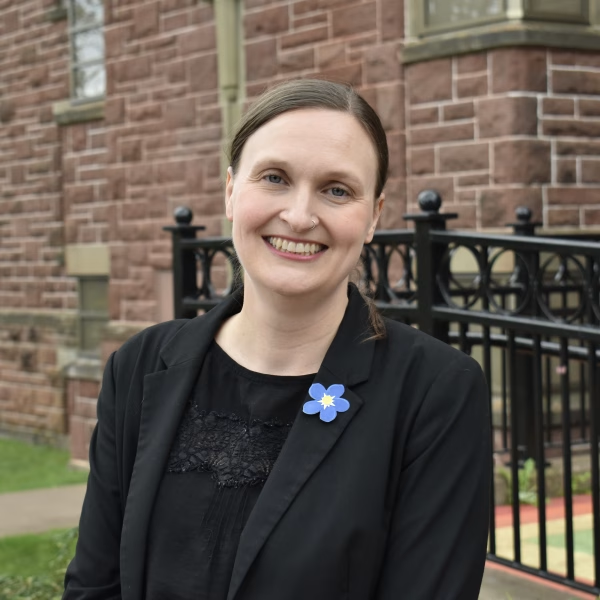
Sacha DeWolfe has explored why parts of that picture can be absent from the way First Nation communities are understood. DeWolfe, a member of Natoaganeg First Nation and an assistant professor at Mount Allison University, describes it as a damage and deficit understanding.
Growing up, she said what she encountered about First Nation people in classrooms and the media often presented a problem that needed to be fixed. It didn’t resemble the family she knew. DeWolfe described her mother as caring and hard-working, while her sisters went on to be successful.
DeWolfe later explored the idea through her academic work. Difficult history still has a place in these conversations, she said, but it shouldn’t be the only place they start. Statistics can also contribute to a deficit view when they are used to understand a community without the lives behind them.
“You cannot understand a person or a community by numbers or statistics like that,” DeWolfe said.
Damage goes further, she said, when an entire group of people comes to be understood as damaged. That can obscure the relationships within communities and what people are creating there.
“You miss just the beautiful way of life that’s there, but also the innovative things that are happening, the contemporary things that are happening,” DeWolfe said. “We’re not just sitting there devastated from the colonization of our people.”
Augustine said Elders hold a particular place in families because of the knowledge and wisdom they have accumulated. “They took care of us when we were helpless, and now we take care of them,” she said.
Language can carry those relationships too. Augustine described words for older children that come with responsibilities toward younger siblings, helping families continue if anything happened to the parents. Living around other speakers also gives people the chance to hear the language from Elders.
That passing of knowledge was interrupted. Augustine said older generations could become afraid to teach children their language or cultural practices because they worried about the racism those children could face. She now sees young people moving in another direction.
“They are taking pride in their culture,” Augustine said. “They’ll dress in their full regalia. They are learning the language.”
She sees young people returning to practices that earlier generations were discouraged from carrying forward. “The drum was silent,” Augustine said. “But now they’re drumming.”
Richard “Dick” Paul remembers asking his parents to teach him their language when he was about 10 or 11. Paul, a Wolastoqey knowledge keeper from Kingsclear First Nation who previously taught Native Studies at Fredericton High School, said they refused, telling him he would “never get a job” with his language.
When Paul later lived with his grandmother, she agreed to teach him on one condition: he couldn’t tell his parents.
Paul kept the secret until he was about 21. One day his parents were speaking about him in their language while he was sitting nearby. He surprised them by answering. His mother eventually began speaking the language with him, including when he drove her to bingo.
“It felt good to be able to learn that again and to speak the Native language,” Paul said.
Years later, Paul tried to organize a drumming group while teaching at Fredericton High School, but said students were too shy to participate publicly. At a Truth and Reconciliation event this year, he watched five young women who had attended the school drum during a ceremony.
“Now we see the confidence in our young people becoming stronger,” Paul said. “They’re being more proud of who they are.”
Nicole Porter, an Indigenous student advisor, said she grew up without much of the cultural knowledge young people in her community are now seeking.
“For me, I grew up without the culture, and I didn’t know how to approach an Elder,” Porter said. “I didn’t know what to say. I didn’t know, like, what was a smudge or tobacco offering or anything like that.”
Porter said more young people are asking questions about their culture. As Elders feel safer teaching, she said her generation can learn from them before passing that knowledge on.
Stanley Barnaby, CEO of the Joint Economic Development Initiative, or JEDI, said success in First Nation communities does not always receive the same attention. In his work, he has watched communities create economic opportunities for themselves.
“We have successful businesses. We have successful Indigenous people, and that is not celebrated enough,” Barnaby said.
Barnaby said JEDI has operated a business incubator for about eight or nine years. He has watched young First Nation entrepreneurs turn their interests into businesses.
Karl Hele said Elders in his home community encouraged him to look at what people did in their everyday lives, not only colonialism and land loss. Hele, an Anishinaabe scholar from Garden River First Nation in Ontario and a professor and Canadian Studies program head at Mount Allison University, said those histories remain part of his research.
He points to an old council hall in Garden River. The Indian agent exercised authority there, but community members also made the building their own. It became a place where people celebrated important moments in their lives.
“They saw it more as a place of community and celebration rather than as a band office where the Indian agent told us what to do,” Hele said.
Junior Peter-Paul, a Mi’kmaq knowledge keeper from Elsipogtog First Nation, spoke during a Community Talk and Cultural Teaching at Mount Allison University. During the session, he gave participants rocks that they could keep afterward.
Peter-Paul said he wanted people to hold onto the rocks and think about “where they stand, what they feel, and what they can learn out of them.”
Augustine describes some of the changes she sees today as intergenerational healing.
“We are absolutely not victims,” Augustine said. “We are still following the ways that the Creator gave us. We are still following the original instructions from the Creator, and we are very resilient. We are still here.”
When asked what journalists should pay attention to outside moments of crisis or days such as Sept. 30, Augustine said there are stories of success happening within First Nation communities throughout the year. She encouraged journalists to come and listen.
“Come back and listen to the stories of success, what is working in our communities,” Augustine said. “We have a lot to offer.”
.