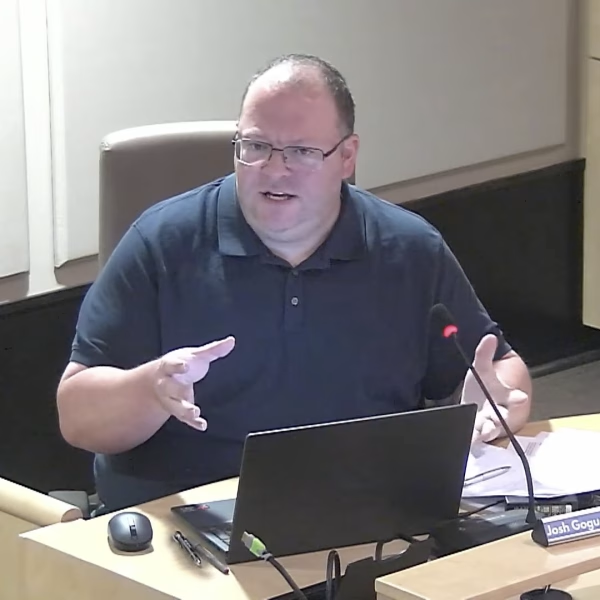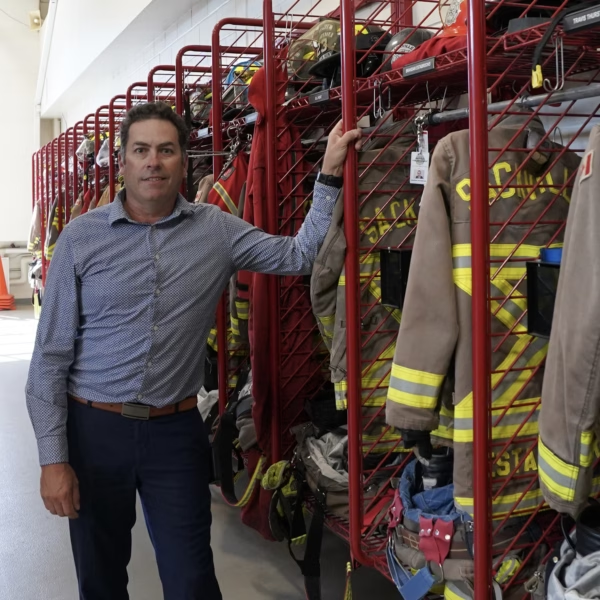

Mount Allison professor Josh Kurek admits he doesn’t know much about Armenian politics. Which is why he was shocked and confused to discover a video of himself online, appearing to talk about the Armenian genocide, and the current Armenian Prime Minister’s attitude towards it.
Hear this story as reported on Tantramar Report:
The faked video uses about four seconds of actual footage of Kurek introducing a five-minute ‘mini-lecture’ produced by Mount Allison to promote its environmental science program. But then the faked video switches to historical still images and a clone of Kurek’s voice.
“I have a lot of students from Armenia,” says the faked Kurek voice. “And it was very interesting for me to learn from them how the memory of the Armenian Genocide is viewed in Armenia.” The faked Kurek then goes on to posit that the current Armenian government is attempting to “erase the memory of this tragedy” before urging viewers to “share this video with your family and friends in Armenia via ‘messengers’.”

CHMA discovered the fake Kurek video on the website the Insider, which describes itself as “a Russia-focused, independent media outlet” which is “fully committed to investigative journalism and to debunking fake news.” The site claims that the fake video is made by Matryoshka bots aiming to discredit the Armenian prime minister, Nikol Pashinyan.
“I was shocked to see myself on that website and as part of that obviously fake news article,” says the real Josh Kurek. “I was confused. I wondered how they got some of that footage, and then I sort of felt a little bit silly seeing that I was in that position of being associated with a genocide.”
“I was saddened,” says Kurek, “because I realized that this can probably happen to anyone, and the effects could be life changing, depending on the severity of the fake news story.”
For Kurek, the subject matter is so completely unrelated to his actual profession as an aquatic scientist that he likely won’t suffer negative consequences from the faked video. But that doesn’t mean internet fakery is harmless.
‘It’s very concerning’
Sociology professor and fake news expert Erin Steuter says the technology to fake audio and video is becoming more sophisticated and available.
“It’s very concerning,” says Steuter. “There are really very few safeguards in place to prevent this.”
The voice cloning technology used in the faked Kurek video has developed in recent years, says Steuter. “Some of the companies that develop it say that they only need 10 seconds of your voice in order to create something like that.”
Steuter says that fakes can target individuals, such as in so-called ‘grandparent’ scams where voice clones of loved ones can fool well-meaning and caring people into sending money or sharing information with bad actors. And fakes can also target larger groups, sometimes with specific political aims, or sometimes just to sow chaos.
“There’s been several cases of the Pope giving sermons that he didn’t give, or public figures weighing in on contemporary global debates,” says Steuter.
“It’s definitely incredibly disruptive of at the individual level and at the larger societal level,” says Steuter. And the increasing prevalence of fakes are breaking down trust, says the sociologist. “People are just like, do I answer my phone?… The Pope just gave an inspiring speech in the news, and you’re like, how do I know that was really the Pope?”
“If you think about journalists and the other sort of ‘fact checking’ professions, it’s so difficult for them to even try to do that and do it in a timely manner,” says Steuter. “The fake news has gotten out before the real news can even be verified.”
Steuter’s 2020 book, Won’t Get Fooled Again, is a graphic guide to protecting oneself in the fake-news-ridden internet.
Steuter says there safety tips and recommendations to follow, such as creating a safe word in a friend group or family to make it possible to weed out a fake if needed. But so far, says Steuter, the attitude is ‘buyer beware’, leaving it up to individual to try to defend against the onslaught of fakery.
“There seems to be a reluctance to regulate some of the new tech inventions being unfolded, causing all kinds of havoc,” says Steuter. “At some point there may be a political will, driven by consumer frustration and unhappiness, to start to put safeguards into place and try to mitigate the damage, sort of after the fact.”
All in all, there’s not a lot of good news when it comes to fake news, says Steuter. And there may not be much that someone like Josh Kurek can do to disable or remove a fake video featuring himself and his voice.
“It’s very, very difficult to pull down a video,” she says. there’s just such a huge scale infrastructure on TikTok or YouTube and things like that, so that they need to have various kinds of passkeys and things like that installed in order for you to be able to say that’s not me and take that down.
“We need political will and pressure in order to put that type of regulation in place,” says Steuter.
Kurek says he has asked Mount Allison to take up the cause. “This was a video that I made on their request describing our degree programs and learning opportunities in environmental science. So I’ve asked them to see if there’s anything that they can do about that, and they said that they’re looking into that,” says Kurek.
Ultimately he says the experience can serve as a sort of warning. “You should look very closely at any information you’re you’re taking away from the internet,” says Kurek. “The technologies are very sophisticated now, and with voiceovers and images, they can easily be faked. So you want to make sure that you’re you’re getting your information from credible and reliable sources.”