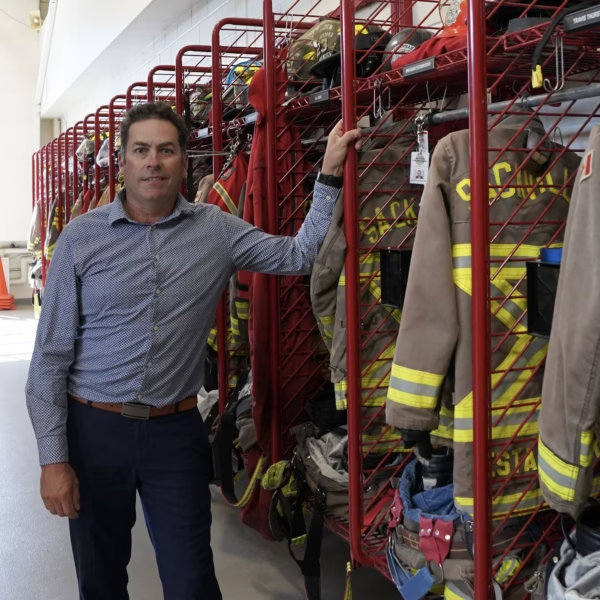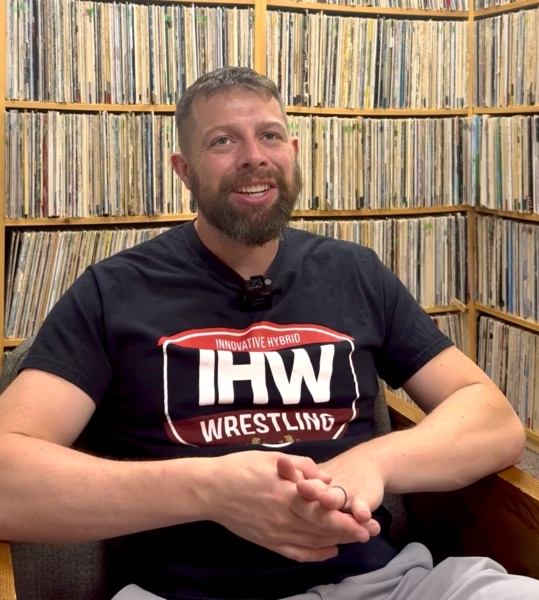


Keith Hart says mosquitoes have made it harder for his family to enjoy being outside in Sackville this summer.
Hart, a middle school teacher who has lived in Sackville since May 2021, said his family used to regularly eat on their deck from late spring into early fall. There would be the occasional mosquito, but this summer has been different.
“I have not worn shorts all year long, all summer, simply because even with bug spray, I’ll still be bit, and it’ll be uncomfortable,” Hart said.
Hart said mosquitoes have been noticeable throughout the day, from early morning dog walks to the afternoon and especially in the evening. At Chester Cole Field, where his son plays baseball, he said players seem to spend more time swatting mosquitoes than in previous years. Some parents, he said, have taken to watching practices from inside their vehicles.
Hart isn’t the only person to notice a difference.
Mount Allison University’s Liza Barney told CHMA she has also noticed what she described as an “unusual abundance of mosquitoes” this summer.
The weather over the past two summers offers one possible clue as to why.
Laura Ferguson, an assistant professor of biology at Acadia University who researches mosquitoes, said the amount of available water can have a major effect on mosquito numbers. Mosquito larvae develop in water, leaving fewer places for them to develop during dry periods. A wetter summer can bring some of that habitat back.
“In years that we have more drought-like conditions, certainly like we had last year, sometimes that really limits that juvenile stage, and then we don’t get as many adults flying around and biting,” Ferguson said.
More consistent rainfall and standing water can allow mosquito numbers to rise again, while warmer temperatures can speed up their life cycle in some circumstances.
After the interview, CHMA asked Ferguson specifically whether last year’s drought followed by wetter conditions this summer could contribute to what residents are noticing.
She said it makes sense from a mosquito biology perspective. Drought reduces the availability of standing water, while some mosquito eggs can survive dry conditions for an extended period. Because females can deposit eggs above the water line, rising water can potentially allow eggs from a previous year to hatch alongside eggs laid during the current year.
The explanation does not establish that Sackville has more mosquitoes this year, or that weather caused an increase. Ferguson said answering that question would require consistent surveillance.
No long-term mosquito count in Sackville
Ferguson said observations from people who have lived in an area for years can provide useful information about changes they are experiencing.
“People who’ve been living in a certain area for a long time, they know from year to year what that abundance is like,” Ferguson said.
But establishing an increase scientifically requires standardized monitoring. Mosquitoes can be trapped, identified by species and counted, with the same work repeated from year to year.
“If we really wanted to have some solid data, we would have to do some standardized surveillance,” Ferguson said.
Neither New Brunswick Public Health nor Mosquito360 provides that kind of consistent mosquito-abundance surveillance in Sackville.
Department of Health communications officer Morgan Bell told CHMA that Public Health does not routinely monitor mosquito abundance. Public Health instead conducts surveillance for specific mosquito-borne diseases that are reportable in New Brunswick.
The Southeast Regional Service Commission does operate a mosquito management program in southeastern New Brunswick, but Tantramar does not participate.
Mosquito360 is an optional service currently provided to Moncton, Dieppe, Riverview and Fundy Albert. Crews in those municipalities monitor mosquito breeding habitat and sample larvae to help determine whether treatment is needed.
Tantramar is outside the program, so that monitoring and treatment does not take place in Sackville. The Southeast RSC told CHMA it has no Sackville-specific mosquito data to show whether this summer is unusual.
Hart has wondered whether retention ponds and other areas of standing water near places where he has noticed mosquitoes could be contributing. Ferguson said larval sampling could determine whether mosquitoes are developing in a particular body of water, but there is currently no monitoring data linking Sackville’s retention ponds to the mosquitoes residents are encountering this summer.
Tantramar was told about the program last year
Tantramar council heard about Mosquito360 during an October 2025 presentation from the Southeast Regional Service Commission.
Stephanie Thorne told council that Tantramar did not contribute to the non-mandated service. When a councillor asked how many municipalities participated, Thorne identified Moncton, Dieppe, Riverview and Fundy Albert.
“If anybody else wants to join, we’re open to it any time,” Thorne said.
No reason for Tantramar’s non-participation was given during the discussion, and the cost of joining was not discussed.
The Southeast RSC later confirmed to CHMA that neither the Municipality of Tantramar nor the former Town of Sackville participated in its mosquito-management services.
Tantramar communications officer Sara Ericsson said Ron Kelly Spurles, the municipality’s manager of tourism and business development and staff representative attached to the Climate Change Advisory Committee, has worked with the committee to contact the RSC for more information about Mosquito360.
The information is being gathered for the committee to review as part of its work advising on climate-related projects. The municipality has not said it is considering joining the program.
Ericsson said the municipality could not confirm reports of higher-than-normal mosquito numbers this year. She said it has heard anecdotally that last year’s drought may have temporarily reduced mosquitoes, while this summer’s heavier rainfall may have contributed to higher, though not necessarily abnormal, numbers.
Ferguson’s explanation supports the biological possibility of that pattern, but not that it is definitively responsible for conditions in Sackville.
Long-term monitoring could answer what one summer cannot
For Ferguson, the larger missing piece is long-term surveillance.
Mosquito numbers can vary considerably from one summer to the next depending on conditions such as temperature and rainfall. That makes it difficult to tell from a single summer whether mosquito numbers are actually changing over time. Ferguson said researchers would need to count mosquitoes in the same places year after year to know.
“What we really need is long-term surveillance,” Ferguson said. “We need annual reports of the abundance of mosquitoes in areas that we routinely sample, the same area over and over, year over year.”
For now, last year’s drought followed by wetter conditions this summer offers a possible explanation for what Hart and others have noticed. But without mosquitoes being consistently counted in Sackville, there is no way to say whether there are actually more of them than normal.
Social licence and consultation with First Nations, two issues at the heart of the original moratorium, also remain part of the test. The Holt government says it intends to make a final decision in January.

Theodore Ramharack holds a Bachelor of Arts in Political Science from Western University and a diploma in Broadcast Journalism. He recently completed an internship with CBC News’ The National.
Originally from Ontario, he moved to Sackville to join CHMA as a local journalist and is excited to get to know the Tantramar region and share stories from the community.