
Sixteen recording units placed in forests along the Fundy coast are helping researchers look for a threatened songbird whose presence in the region remains largely unknown.
The units are part of Fundy Thrush Watch, a project led by the Fundy Biosphere Region to search for Bicknell’s Thrush in an area where the bird has been detected in the past, but where little monitoring has taken place.
Jenna Cowie, conservation project manager with the Fundy Biosphere Region, said those historical detections caught her attention.
“I had learned that there were potential sightings through time of Bicknell’s Thrush on the Fundy coastline, and not a lot of work has been done about it,” Cowie said. “So, we sort of have the question of are they there? What habitat are they using, and can they be found?”
Cowie has worked with Bicknell’s Thrush before and said the project fits with Fundy Biosphere’s role of finding gaps in conservation work and bringing regional partners together.
Birds Canada already has an extensive Bicknell’s Thrush monitoring program, but much of that work has taken place in northern New Brunswick. Fundy Biosphere, meanwhile, has partners and connections throughout the Fundy region.
“All the pieces just sort of fell into place,” Cowie said.
Amy-Lee Kouwenberg, associate director of Atlantic programs with Birds Canada, said her organization is interested in what the project finds.
“We’re very excited about this project that they’re doing in the Fundy region because it’s an area that we have actually not looked,” Kouwenberg said. “We just haven’t had the capacity to deploy ARUs and go looking in this area.”
Kouwenberg said there have been historical detections along the Fundy coast, but the area remains “kind of an unknown.”
“It’ll add to the full picture of Bicknell’s Thrush in New Brunswick,” she said.
Seven hours a day in the forest
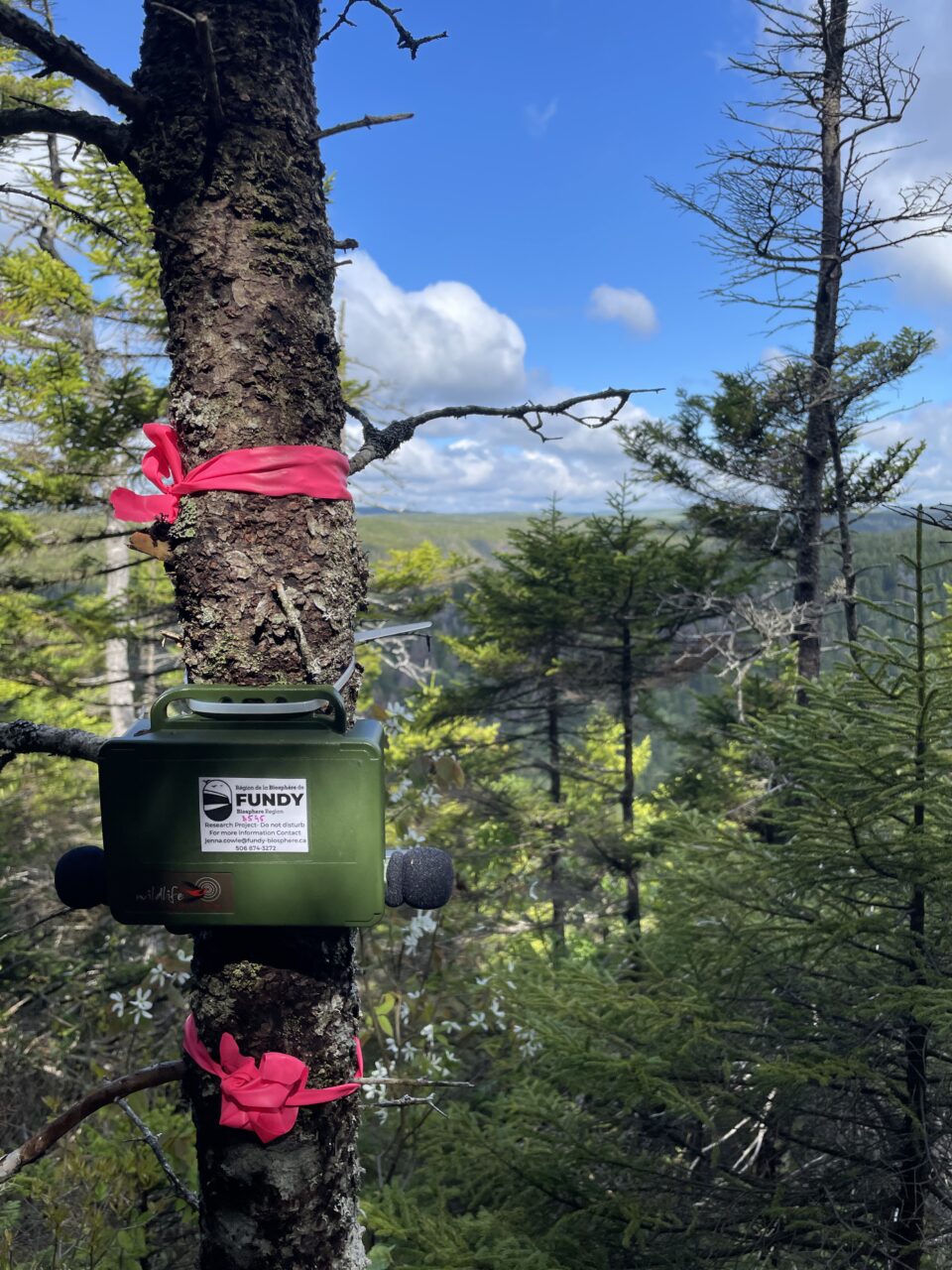
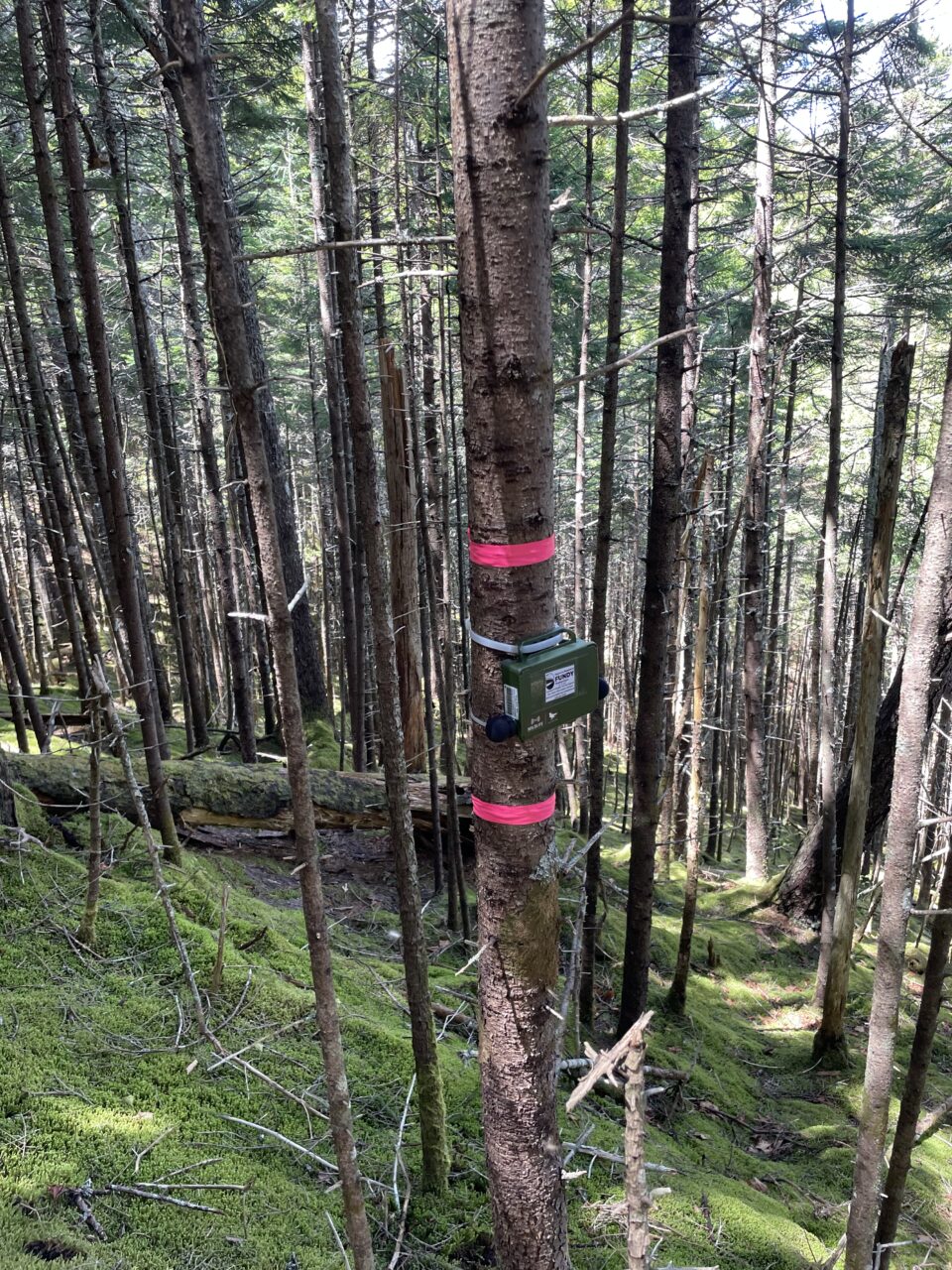
Fundy Thrush Watch deployed 16 autonomous recording units, known as ARUs, at sites selected using historical research and information from Birds Canada and Environment and Climate Change Canada.
The recorders were set to run for two hours before and after sunrise, and for an hour and a half before and after sunset. That gave researchers seven hours of audio each day during some of the busiest periods for bird calls.
For Cowie, getting the recorders into position meant travelling through remote and sometimes difficult terrain. Some areas were so steep, she said, that the team was “pretty much on our hands and knees” trying to get over hills and around trees.
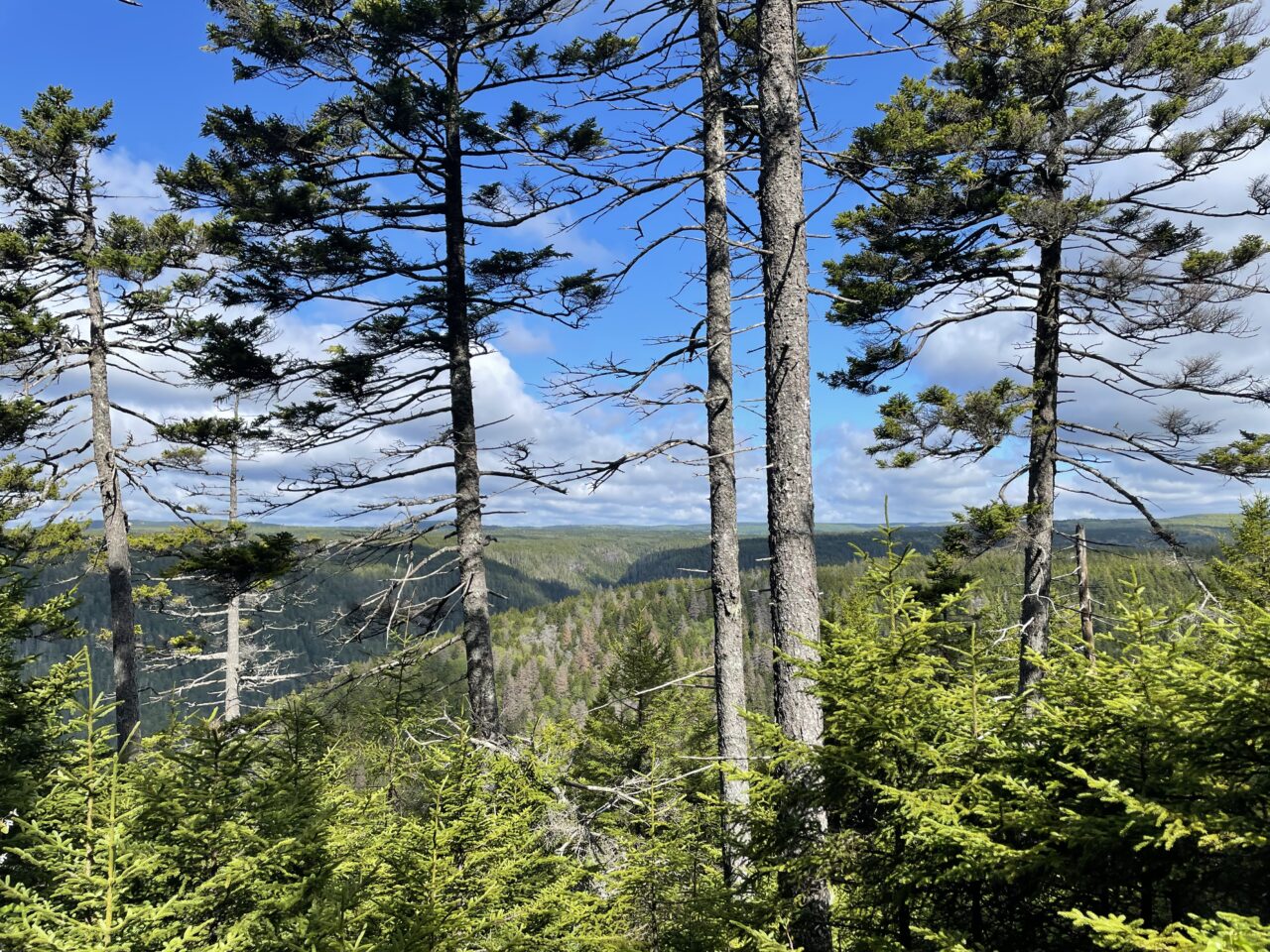
The dense forest that made the fieldwork difficult is also part of what makes the area suitable for Bicknell’s Thrush.
Kouwenberg described the species as extremely secretive. It lives in thick forest and is much more likely to be heard than seen, making acoustic monitoring particularly useful.
A traditional bird survey might give a trained researcher about 10 minutes to listen at one location. An ARU can stay in place for days.
“With the acoustic recorders, we can go out to places that, you know, we don’t normally go, and have it up for six days or more,” Kouwenberg said.
Birds Canada has seen the difference that extra listening time can make.
Kouwenberg said researchers in Cape Breton had stopped hearing Bicknell’s Thrush during traditional surveys at some locations where the species had previously been detected. It was unclear whether the birds had disappeared or were simply being missed during the short surveys.
Researchers left acoustic recorders behind and detected the birds.
“We found they are still here,” Kouwenberg said. “It’s just you have to spend many minutes listening before you hear them.”
430 gigabytes, and no answer yet
The 16 Fundy recorders returned with about 430 gigabytes of audio.
The recordings contain more than the calls researchers are looking for. Cowie said she has heard wind, rain, other breeding birds and occasionally wildlife moving around the recorders.
“You get these windy days and these soft, rainy days and, you know, sometimes you even hear wildlife moving around,” she said.
Those recordings can also be archived and revisited if researchers want to look for other species in the future.
For now, the focus is Bicknell’s Thrush.
The audio is being processed using software called Call Seeker, which pulls out potential calls and gives them a confidence rating. Researchers still have to review those results before a detection can be confirmed.
That work was not finished when Cowie spoke with CHMA, and she cautioned against expecting a definitive answer from the first year of the project.
A 2023 draft provincial species-at-risk recovery plan identified areas of recovery and survival habitat for Bicknell’s Thrush. Cowie said a small area of identified survival habitat falls within the region being studied.
Her question this year is whether the birds are using it.
“Are Bicknell’s Thrush using that survival habitat?” Cowie said. “It’s a super high-level question. Like, are they there? Are they not there?”
“I wouldn’t even say that this survey was conclusive enough to answer that question, but it’s a preliminary analysis.”
A detection could open up another set of questions. Cowie said future work could look at what habitat the birds are using, when they are there and how many may be present.
Habitat under pressure
Bicknell’s Thrush is listed as threatened, and Kouwenberg said Birds Canada’s monitoring since 2002 has shown its population declining in the Maritimes. Similar declines have been recorded in the United States.
Habitat is one of the concerns. Kouwenberg said about 95 per cent of Bicknell’s Thrush habitat in New Brunswick overlaps with active forestry activity.
The relationship is complicated. About eight to 10 years after a clearcut, she said, regrowth can create the dense habitat the bird favours. That is also around the stage when forests have traditionally undergone pre-commercial thinning, which can make the habitat unsuitable again for at least 10 years.
Birds Canada has worked with forestry companies and provincial governments to avoid thinning in important areas of suitable Bicknell’s Thrush habitat.
The bird also spends part of its year far from New Brunswick. Kouwenberg said its non-breeding range is primarily on Hispaniola, home to Haiti and the Dominican Republic, where habitat loss is another concern.
Researchers are still trying to understand where the birds stop during migration. Kouwenberg said climate change and changes to high-elevation forests could also affect the species.
Cowie said knowing where Bicknell’s Thrush can be found is one of the basic pieces researchers need before they can answer larger conservation questions.
“They’re a really unique species. They’re a habitat specialist, so they really don’t occur everywhere,” she said. “We should take pride that we have forests and environment that can support species like this.”
Fundy Biosphere is also producing a short film about Fundy Thrush Watch. Cowie said the project has drawn support from organizations and people across the region who want to know what the recordings reveal.
“Everybody really wants answers

Theodore Ramharack holds a Bachelor of Arts in Political Science from Western University and a diploma in Broadcast Journalism. He recently completed an internship with CBC News’ The National.
Originally from Ontario, he moved to Sackville to join CHMA as a local journalist and is excited to get to know the Tantramar region and share stories from the community.