
The New Brunswick government is reminding people to watch for cyanobacteria this summer, but no lakes in the Tantramar region have recorded blue-green algal blooms.
“To my knowledge, there are no lakes in the Tantramar region that have recorded blue-green algal blooms,” said Joshua Kurek, an associate professor of environmental science at Mount Allison University.
“They’re definitely there, but they just haven’t happened yet.”
Cyanobacteria, often called blue-green algae, have been around for about two billion years. Kurek said they’re found in water and soil around the world and produce much of the oxygen we breathe.
Most aren’t a problem.
“The concern is when they become very, very abundant,” Kurek said.
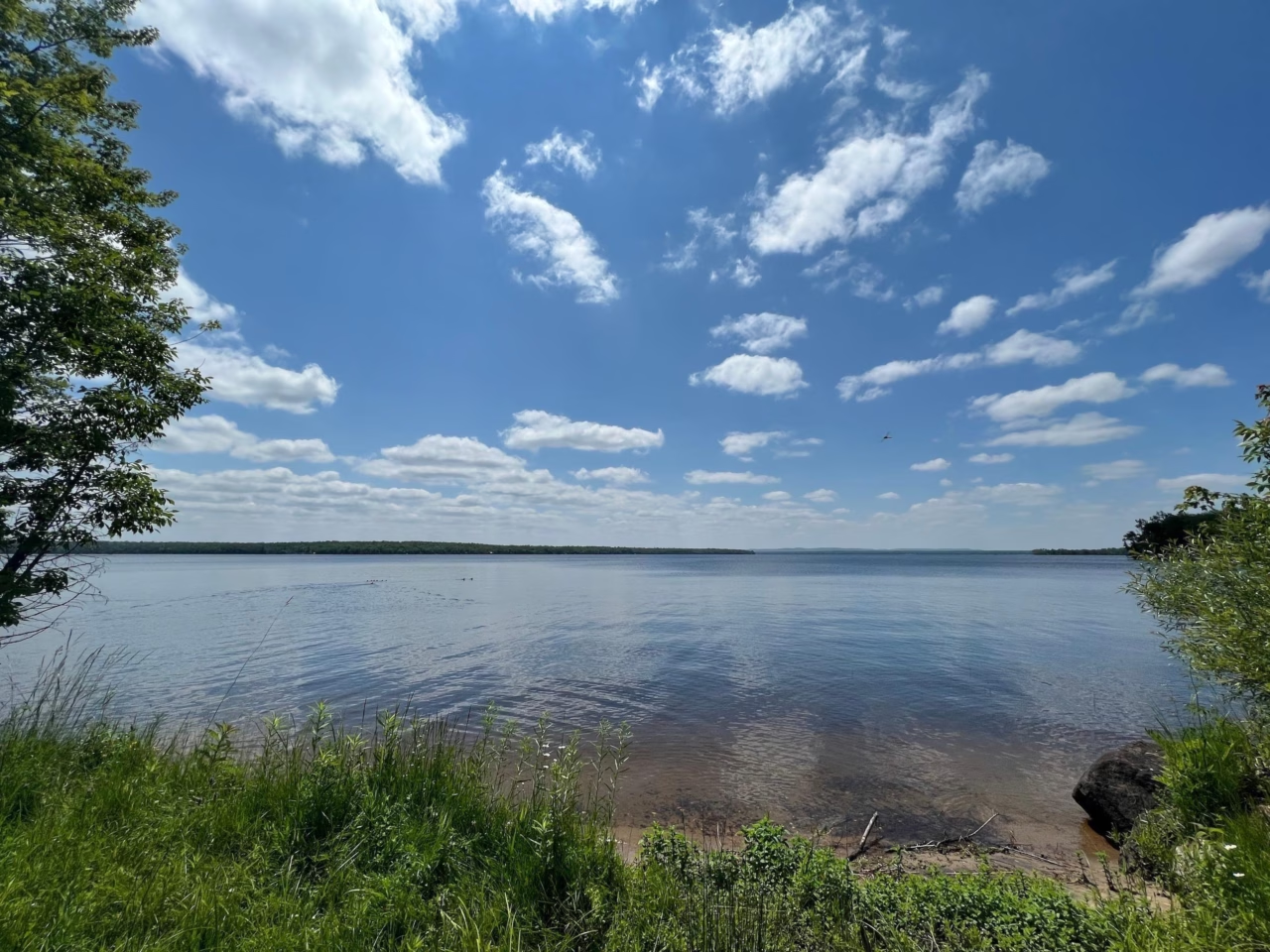
Some blooms produce toxins, while others don’t. They can show up as a green film on the water or as stringy patches below the surface and along the bottom of lakes and rivers.
The problems don’t end when a bloom dies.
“They eat them, basically,” Kurek said of the organisms that break down the dead bacteria.
Breaking the bacteria down uses oxygen. If enough of it disappears, there is less available for fish and other organisms living in the water. Kurek said oxygen is an important measure of how healthy a lake is.
Kurek said July and August can bring good conditions for cyanobacteria to grow, particularly when the water is warm and there isn’t much wind.
Nutrients entering the water can add to it. He pointed to farm runoff after storms and industrial pollution as examples. Changes among the organisms living in a lake can matter too, particularly if fewer of them are feeding on the cyanobacteria.
Scientists haven’t always understood blooms in the same way.
“The idea that you see these blooms of cyanobacteria, decades ago, they would’ve been attributed to nutrients moving into the system,” Kurek said. “What we’re seeing now is more evidence that changes in weather patterns linked to climate warming are associated with these blooms.”
Kurek and his team are studying about 40 lakes across the St. John River watershed.
It starts with mud from the bottom of a lake. As cyanobacteria die, they leave behind tiny pigments that stay there. Over time, the mud becomes a record of what has happened in the lake.
Getting that kind of information by regularly monitoring lakes is difficult.
“Resources are limited,” Kurek said.
About 40 lakes are regularly monitored in New Brunswick, but Kurek said “regularly” might mean a visit once every few years. A bloom, meanwhile, can develop quickly when the weather is hot and the water is calm.
People who spend time at those lakes can help catch what researchers miss. Kurek said people now regularly send in photos and reports after noticing something while they’re out on the water.
The effects of a bloom aren’t limited to what happens in the water.
“If you’ve got a house on a beautiful lake, and maybe it’s a summer house, and that lake starts showing algal blooms, that will directly impact the value of your investment,” Kurek said.
A lake dealing with repeated blooms could eventually spend much of the summer under advisories, he said. That could change whether people can swim there or what fish can survive in it.
Kurek doesn’t see cyanobacteria as something with a simple cause or an easy fix. Blooms can be part of what naturally happens in a lake, while others can be pushed along by what people are doing around the water or by changes in the climate.
“So it’s a complex problem,” he said. “It’s not easy to find solutions to either.”

Theodore Ramharack holds a Bachelor of Arts in Political Science from Western University and a diploma in Broadcast Journalism. He recently completed an internship with CBC News’ The National.
Originally from Ontario, he moved to Sackville to join CHMA as a local journalist and is excited to get to know the Tantramar region and share stories from the community.