

Ever since news started to spread about plans for a new natural gas-burning power plant in rural Tantramar, there’s one question that has dominated reactions from the region: why here?
The proposed location for the ten-turbine, 500-megawatt plant certainly seems strategically placed, at the crossroads of the Maritimes and Northeast Pipeline (which brings natural gas from the eastern US up into Canada) and NB power’s major electricity transmission corridor to PEI (which supplies the island province with nearly 70% of its electricity). But the proposed site is also at another significant crossroads, says Barry Rothfuss, co-director of the Atlantic Wildlife Institute, located about 4 kilometres away as the crow flies from the proposed gas plant.
“It just happens to be the spot where all the migration–the terrestrial mammal migration–merges together,” says Rothfuss, pointing to a recent map published in Canadian Geographic as part of a feature highlighting the Chignecto Isthmus as one of the important ecological corridors in Canada.
“This whole region is identified internationally as a really critical habitat that needs to be protected because it affects wildlife populations on both sides of the provincial boundaries,” says Rothfuss. “It also is right in the core of the Atlantic flyway.”
Rothfuss and his partner Pam Novak operate the Atlantic Wildlife Institute, where they rehabilitate wild animals and are also certified to respond to wildlife disasters and emergencies. The couple are asking why NB Power, after having reportedly considered a number of possible locations, has opted to build a gas power plant in a relatively pristine rural setting, smack dab in the middle of the Chignecto Isthmus.
“It’s shocking, to be honest with you,” says Novak. “It’s absolutely shocking to us that this is happening this close to us here, in this region that is such an environmentally sensitive part of the province.”
Rothfuss says the surveys completed by the proponents of the project, PROENERGY Canada (under contract to NB Power) “don’t even come close to representing what the ecological sensitivity in that zone is, not to mention the water table that feeds down into a very vibrant and productive water system that has huge fish and amphibious populations.”
Rothfuss says the water system is part of the wetlands connected to the nearby Tintamarre National Wildlife Area, a federally protected area around Big Jolicure Lake and Goose Creek.
Rothfuss has a number of concerns when it comes to the natural gas facility, including risks of incidental spills or larger scale disasters from fuel stored on site, impacts to wildlife from the sounds produced by the jet engine-like turbines, air pollution from the gas burning turbines, and possible strain on local water resources.
“A lot of this just doesn’t make sense when you look at it,” says Rothfuss, “from the construction phase to the operation phase, and then the decommissioning phase, every single one of those steps has a significant potential of creating land, air and water damage.”
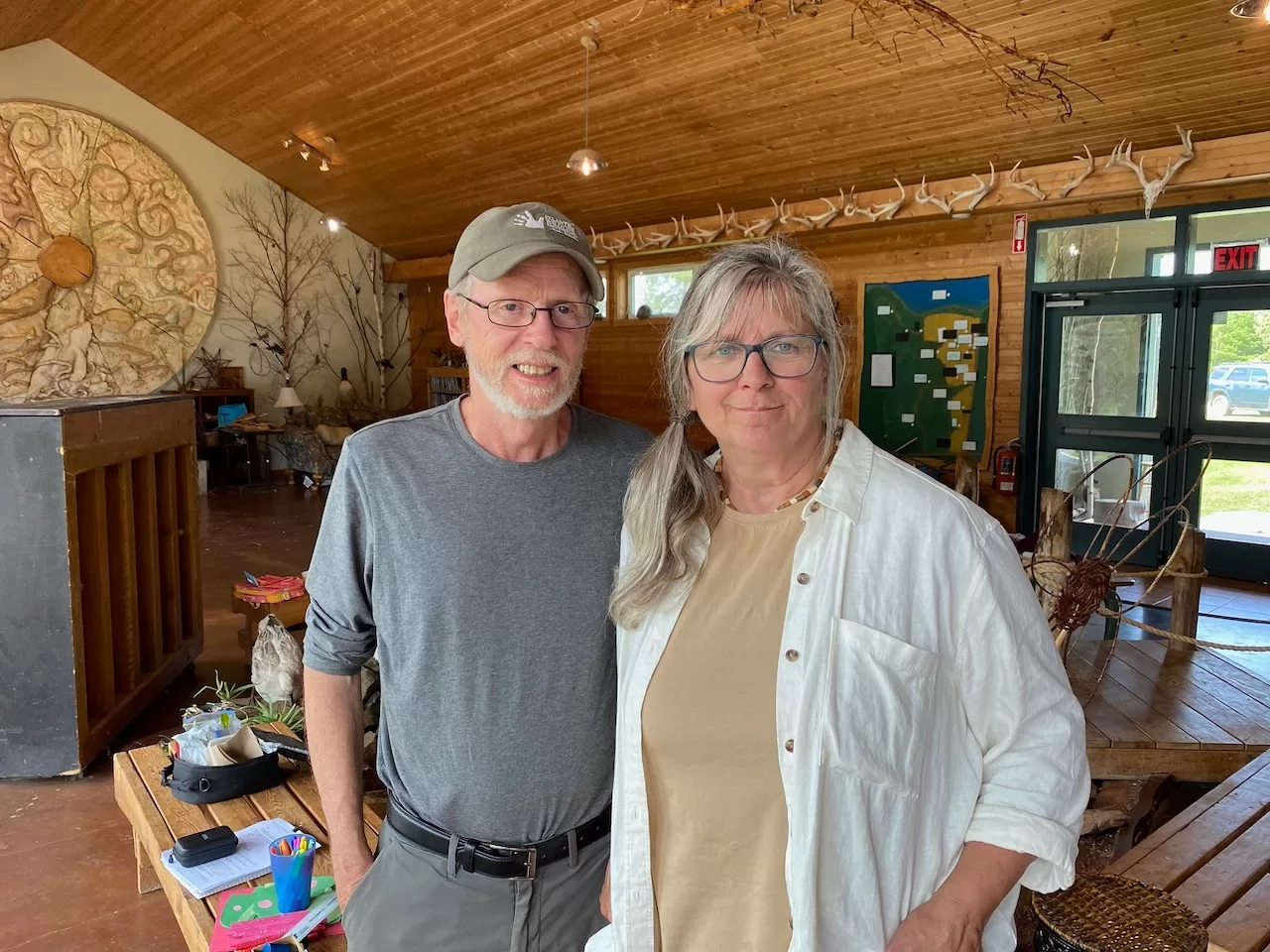
For Rothfuss and Novak, the question of how Centre Village, just north of Midgic, became the preferred site for the industrial project persists, even after a “cordial” meeting last week with John MacIsaac, president of PROENERGY Canada.
“It was respectful,” says Rothfuss. “I listened, but I think we both can agree that it didn’t change either one of our positions.”
“The sensitivity of the the Isthmus really wasn’t what he wanted to discuss,” says Rothfuss. “He wanted to discuss the value of what it would do from an economic standpoint and a mechanical standpoint, and not from an ecological perspective.”
Novak says she didn’t find out much more than was in the project description which is part of the federal impact assessment process. “I think the main thing that came out of [the meeting] was the fact that NB Power is the one that’s still making the decisions here,” says Novak, “of where this will go, how this will operate. And I think that’s where the focus really needs to go to in terms of, why did they choose this location?”
CHMA asked NB Power about why Centre Village was chosen, and received this response via email:
“We evaluated a couple of locations in the southeast of the province due to population and economic growth and proximity to existing natural gas and electrical transmission infrastructure. Our team determined that the Centre Village site provided the best opportunity to deliver the project on time and potentially at a lower cost than other sites that contain both electrical and gas transmission infrastructure.”
According to the project description document submitted by PROENERGY as part of the federal environmental impact assessment process, NB Power conducted “biophysical and archaeological field surveys” at two candidate sites: “one near the Scoudouc Industrial Park and the other the current proposed Project location at Centre Village.”
The document goes on to say that, “desktop and field studies found the Centre Village site to have fewer environmental constraints (e.g., wetlands, watercourses, archaeological potential) and therefore NB Power, in consultation with WattBridge and NSMTC [the North Shore Mi’kmaq Tribal Council], selected Centre Village as the preferred site.”
The document says, “additional studies are ongoing to help optimize site design on the selected property to help reduce potential environmental effects associated with project development.”
Novak is not satisfied. “What made this look so attractive, versus other sites that might be already developed or already prepared for industrial type of projects?” she wonders. “Versus something that’s in such a rural zone that would not have the infrastructure, does not have the emergency services, does not have even the roadways… That’s what we’re still trying to figure out, is why was this chosen over other sites? The reasons just aren’t clear.”
Rothfuss questions why information about the project was so late to reach the community, even though NB Power acquired the land in August 2024, and PROENERGY’s John MacIsaac says the company has been surveying the area for about 10 months.
“I’ve never been involved in a process where the assessment end of the equation comes after the decision of actually doing something,” says Rothfuss. “It’s pretty obvious that they made this decision before they came in and announced the project.”
Novak says that there are layers of concern and questions over the proposed project, including not only why here, but also why build a gas plant at all? And, “why use this type of technology? What are the gains that are going to come out of it?”
Series of public meetings starting Monday
Those are questions that might get answered in a series of public meetings in the coming weeks.
Two public meetings have been scheduled by project proponents PROENERGY, as part of the provincial environmental impact assessment (EIA) process. On August 12 (4pm-8pm at the Sackville Music Barn) and August 13 (4pm-8pm at the Tantramar Civic Centre) representatives of PROENERGY and their project partners (possibly including the North Shore Mi’kmaq Tribal Council, Stantec, and NB Power) will host open houses to answer questions and hear from area residents.
The province is conducting a “determination review” at the outset of the process, and Tantramar MLA Megan Mitton is calling for the department to upgrade that to a “comprehensive review”. Environment minister Gilles LePage has yet to respond.
On Monday, August 11 (7pm, Midgic Church, Gooselake Road) some local area residents have organized a public meeting to discuss the proposed gas plant, and encourage people to submit their comments to the Impact Assessment Agency of Canada (IAAC). The IAAC has yet to determine if they will require a comprehensive federal assessment for the project. As of August 8, the agency has received 127 public comments, and the comment period for the project closes on August 13.
On a municipal level, there won’t be any required public hearings or consultations, because according to PLAN 360 communications officer Marc André Chiasson, the Tantramar Planning Area Rural Plan regulations allow for the project to be built ‘as of right’, because NB Power is a public utility.
Another ongoing review may also include discussions of the proposed gas plant. This summer and fall, NB Power in undergoing a comprehensive organizational review commissioned by the Holt Liberal government. The review is headed up by a panel of three appointed experts and will address priority areas of “financial sustainability, governance and utility structure, investor attractiveness/strategic partnerships, and customer expectations.” The panel plans to do public engagement sessions into the fall, and is hosting an online session on August 20 at 6pm.
Rothfuss says he’s hoping that other organizations with a role in the protection and restoration of wildlife in the Chignecto Isthmus will step up and join the discussion around the proposed plant. “We’re the small player. There are a lot bigger organizations that are involved in environmental protection of the Chignecto Isthmus,” he says. “So I’m hoping that those groups come forward and express their support for our position, because it protects their own interest as well, and the region’s interest.”
PREVIOUS COVERAGE: