
A gas turbine project planned for a rural property near Midgic could employ more than 100 people during its construction, and thereafter between eight to ten maintenance and operations technicians, according to a senior executive with the project.
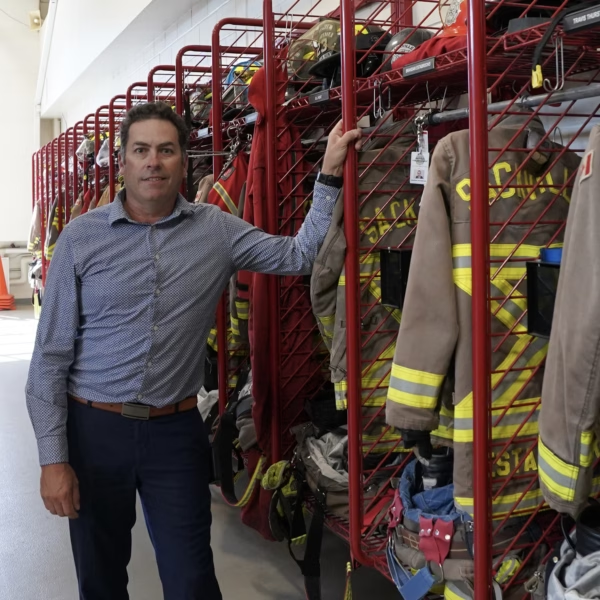
John MacIsaac is president of PROENERGY Canada, a subsidiary of the Missouri-based company which has been chosen by NB Power to build and operate the new gas plant on land they own just off Route 940 near Centre Village, inside municipality of Tantramar boundaries.
MacIsaac spoke to CHMA from Halifax on Wednesday, but said he had been in Centre Village as recently as Monday, when he was “out knocking on doors” with environmental assessment technician Matt Gorman from NB Power. “Matt and I went door to door to say hello to the neighbours and let them know there was an announcement coming out,” said MacIsaac.
NB Power announced the project Monday, the same day that the comment period opened for the project’s federal environmental impact assessment process. The comment period closes August 1.
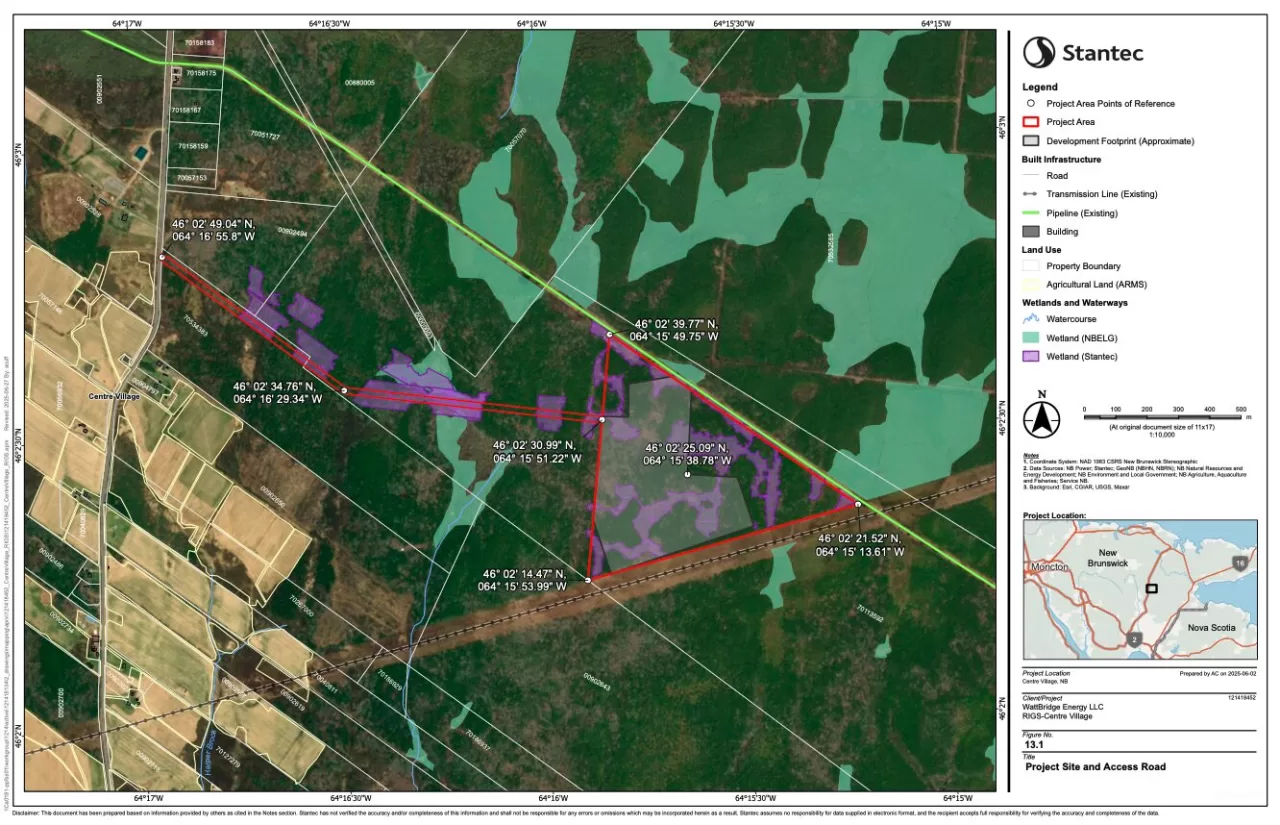
The power generation plant is planned for a property (PID 70113592) acquired by NB Power last August for $300,000, according to Service New Brunswick records. NB Power plans to lease the property to WattBridge, the development arm of PROENERGY, and has agreed to buy power generated on the site for at least 25 years.
MacIsaac and PROENERGY staff have been exploring and investigating the proposed site for about 10 to 12 months. “We’ve been around enough to know some of the neighbours on a first name basis,” says MacIsaac.
NP Power had been considering another site in Scoudouc as a possible location for the new gas plant, but says via email that “the Centre Village site provided the best opportunity to deliver the project on time and potentially at a lower cost than other sites.”
According to Environmental Impact Assessment documents submitted by PROENERGY, the Centre Village site was also preferred by the North Shore Mi’kmaq Tribal Council, who have an equity share in the project. And Centre Village is also conveniently located where the Maritimes and Northeast Pipeline crosses paths with NB Power’s high voltage transmission lines headed to PEI.
“It’s ideally suited in its location,” says MacIsaac, with the facility planned for a triangular site directly at the intersection of the gas pipeline and transmission lines.
NB Power would not make anyone available for an interview on the major project. In their Monday news release the crown corporation says it had forecast a potential shortfall in generating capacity in the province starting in 2028, and the new gas plant will help fill that gap.
NB Power says it chose to pursue a natural gas plant in order to complement its continued “transition to more sustainable energy sources,” such as rewewables like solar and wind power. MacIsaac says the PROENERGY turbines will not only fill intermittency gaps that come with renewable generation, but will also serve to stabilize the grid with voltage support, even when the turbines are not burning fuel.
“What our equipment offers is twofold,” says MacIsaac. “Really, it’s the ability to back up the grid, or strengthen voltage support on the grid, and also provide generation when there’s intermittency in the renewable supply, or we’re in peak winter conditions.”

MacIsaac says the facility’s turbines are designed to respond quickly. “So literally within minutes, less than 10 minutes, we can be online and supporting a dispatch request from the Control Centre at NB Power,” says MacIsaac.
And most of the time, says MacIsaac, the new turbines will not be burning fuel to generate power, but instead operating in “voltage support mode.”
“It ensures that, as the renewables are added onto the grid, that the support for the voltage comes from the generators that are spinning in an emissions-free mode,” says MacIsaac. “So they’re not burning any fuel, but they’re spinning in order to put what the engineers would call inertia back onto the grid.”
McIsaac says that during the construction phase of the new plant, there would likely be over a hundred jobs for skilled workers. Once the plant is operational, slated for late summer 2028, about eight to ten skilled workers can operate it.
And those workers will be “local people on the ground” says MacIsaac, supported by workers in Missouri and Texas on “mimic screens” showing the plant controls. “So the local operators on the ground will have support from subject matter experts that are based in Sedalia and in Houston,” says MacIsaac, “but it’s our commitment to growing local skills and talented operators to operate the equipment on the ground every day.”
Road and water impacts
MacIsaac says he doesn’t expect much traffic impact in the area once the plant is built, but construction, slated to start in 2026, would be a different story.
“Obviously, we’ll do work ahead of time to ensure that we understand the volume of work that’s happening locally and ensure that we manage traffic flows,” says MacIsaac. “We’ll also do things like go in and survey the condition of the roads well in advance, and ensure that we leave things better than we found them.”
The plant will use a significant amount of water, about 7,000 cubic metres per day according to its Water Supply Source Assessment Initial Application prepared by Stantec engineers. It’s not yet known how many wells the project would require, and how it might affect nearby properties. That all has yet to be investigated, says MacIsaac.
“It’s premature for us to say that it would affect local neighbours,” says MacIsaac, “because we have to first better understand the aquifer that we’d be drawing from.”
EIA comment period until August 1
The project is currently undergoing a federal environmental impact assessment, and as part of that process, the Impact Assessment Agency of Canada is hosting virtual information sessions on July 21 and 22 for members of the public to learn more about the project, and find out how to submit comments that will be used to prepare the project’s summary of issues. The comment period closes August 1, and retroactive funding for costs is available to help groups who qualify.
Although the new gas plant will be burning fossil fuels and releasing greenhouse gasses which contribute to further global heating, MacIsaac says that based on NB Power’s calculations, the plant will actually offset more GHG-equivalent emissions than it creates, in part because it is only expected to be generating electricity part of the time. The GHG output, obviously, depends significantly on how much energy its asked to produce.
The Conservation Council of New Brunswick has expressed concern that the new gas plant will actually burn more natural gas than NB Power predicts. In a report by CBC’s Jacques Poitras, the Council’s director of climate policy, Moe Qureshi, says he worries the new facility could be used beyond peak times.
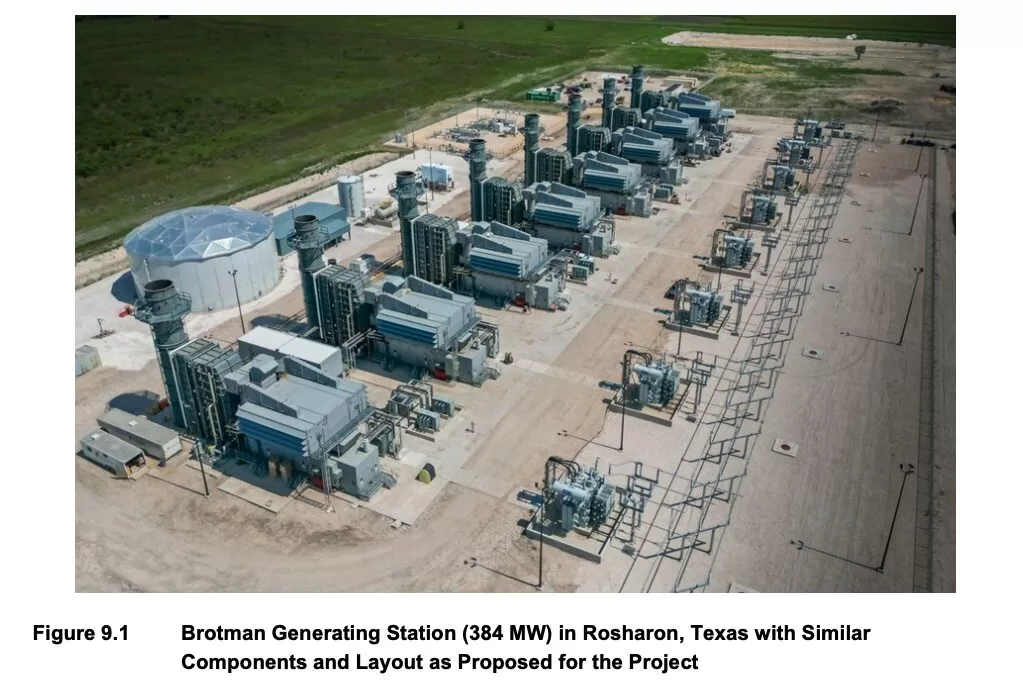
The purchase agreement with NB Power is for 400 megawatts of capacity, but the plant will have ten turbines capable of 500 megawatts. MacIsaac says it will be up to NB Power if it sells extra capacity to its partners in Nova Scotia or PEI.
MacIsaac said the estimated cost to build the project is “commercially sensitive” but said it was in the hundreds of millions of dollars.
PROENERGY has promised NB Power that the new plant will be commissioned and in service in 2028. “To support that, we would be fully mobilized in the spring of 2026,” says MacIsaac. Even earlier, in the fall of 2025, the company hopes to “get in and do some additional site investigative work,” says MacIsaac.