
New Brunswick Public Health has identified 17 new cases of COVID-19 in Moncton, all connected to an outbreak at the Manoir Notre Dame.
There are now 19 cases in the outbreak at the special care home, 13 in residents, 4 in workers, and 2 in family members of residents.
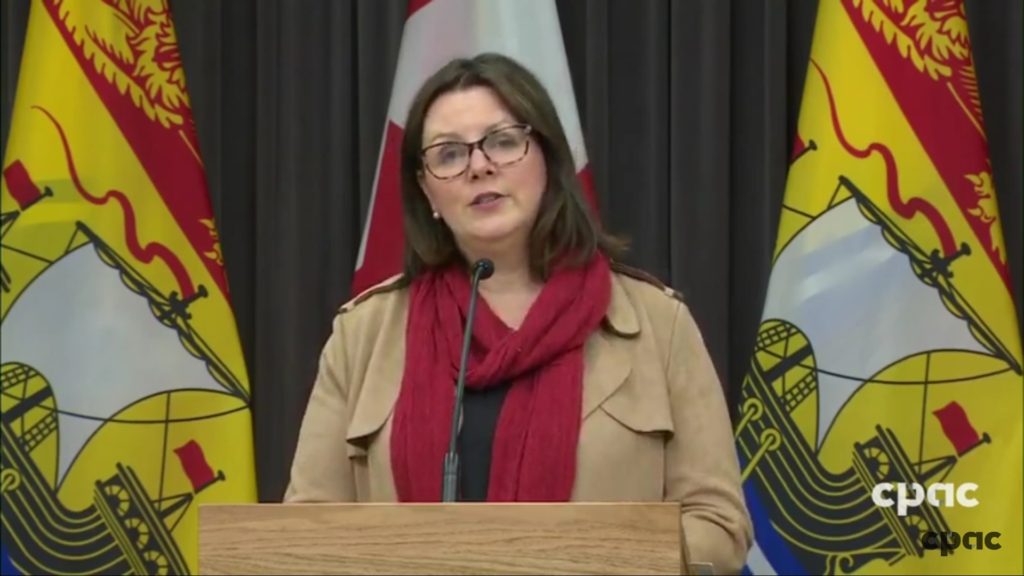
Chief Medical Officer of Health Jennifer Russell said Wednesday afternoon that the surge in reported cases is the result of public health’s rapid response to the outbreak first identified Tuesday.
Russell said almost everyone at the Manoir Notre Dame was tested in a 4 hour period Tuesday, and all family members have been contacted.
The Provincial Rapid Outbreak Management Team, or PROMT, remains on site and is coordinating further measures.
“Contact tracing is underway, and the source of the outbreak remains under investigation,” she said.
So far, public health has identified potential public exposure at the Moncton Costco Optical Centre and at the Moncton St-Hubert restaurant. People who have visited these locations since Oct. 1 should self-monitor for symptoms for 14 days.
Russell said all residents of Manoir Notre Dame are isolated in rooms, staff are being trained with the use of PPE, and restrictions have been placed on visitation.
Russell also said that all close contacts that have been identified to date are in self-isolation.
Reporters asked why the province had not triggered a return to the orange phase for the region, considering that is what happened in Campbellton during the outbreak there.
Russell said the situation is different for a couple of reasons. “One, our phases have changed in terms of what the different phases look like and the triggers,” she said.
“The situation in Campbellton included one adult residential facility, two different daycares and a hospital. So those are multiple settings. Right now, this outbreak is contained in terms of diagnosed cases to one facility,” she explained.
“We do have to make sure that we contact all of the close contacts within 24 hours. So we’re working on that. This is an outbreak in a high vulnerability setting, where there is a risk of transmission to the community. So we’re looking at that as well. So once we gather all that information and finish our risk assessment, then we’ll make a decision about whether to go to orange,” said Russell.
Russell mentioned a few times that lessons have been learned from New Brunswick’s experience with the Campbellton outbreak. One of those lessons appears to be the attitude toward identifying the source of the outbreak and laying blame.
Authorities, and premier Blaine Higgs himself, were quick to identify one person as the source of the Cambpellton outbreak. Though they did not name him publicly, Dr Jean Robert Ngola was quickly identified and became the target of harassment and threats. Since then, there have been doubts cast on whether Ngola was actually the source of the outbreak in Atholville, which killed two people.
Ngola has since left his family practice in Cambpellton, where he also worked in the hospital emergency room.
This time around, Russell is laying the ground for the government to take a different tack.
“We’re not looking for blame in this situation,” said Russell. “At this point in time, we’re really looking for compassion and kindness. And we’re looking for what we need to do to move forward to contain this outbreak at this time.”
Russell said that the hope was for the region to remain in the yellow phase. “New Zealand just came through an outbreak and they were able to do it without having to close down businesses and keep people at home,” she said.
But while she said the province would prefer to remain in the yellow phase, the public health investigation will continue. “Whatever pieces of information we find around what the different potential sources are, then we’re going to look into that and we will certainly investigate that,” she said.