
As Mount Allison University students prepare to return to campus, their student union is putting affordability at the centre of its plans for the coming academic year, with a new need-based bursary, changes to the campus food pantry and an effort to make additional course costs clearer to students.
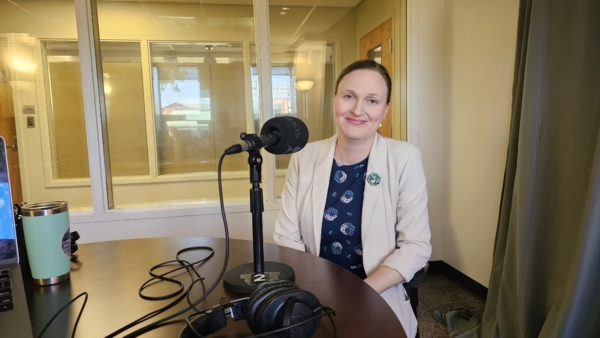
Kassandra Vail, president and CEO of the Mount Allison Students’ Union (MASU), said affordability and students feeling they do not have enough say in their university experience are the two broad issues she hears about most.
“I would say that all or most of the issues come across my desk fall into either an affordability issue or an issue of students not feeling like they have a say in their experience at university,” said Vail.
Vail pointed to tuition and other university costs, along with difficulties finding student employment and housing in Sackville, as pressures contributing to the financial situation students face.
MASU is responding in part with a new Financial Need-Based Student Bursary, which Vail said is the union’s first bursary specifically aimed at students who need financial assistance. The program will begin as a pilot this year.
“It’s becoming an extreme financial barrier to get education,” said Vail. “It’s not accessible for most students, and we want to do everything in our power to make or help in any way that we can with these barriers and ensure that students are able to go here, and they’re not having to choose between paying their tuition and paying rent or buying food.”
Changes coming to student pantry
Food security is another area MASU has been working on over the summer. Mount Allison operates a student pantry in the student centre, which Vail described as essentially a university-run food bank for students. MASU does not operate the pantry, but has taken on an advisory and advocacy role.
Vail said the pantry was not used as much as it could have been last year and may not have been as accessible as students needed. MASU brought those concerns to Mount Allison, and Vail said the university agreed changes were needed.
Vail said she could not yet disclose all the details of the new model, but said making the service free, accessible, approachable and anonymous are priorities.
“It’s anonymous for students to use, and they don’t have to decide between disclosing their personal information in order to receive food that they need,” said Vail.
“We all know students are hungry, and if students are hungry, they can’t study, and they shouldn’t have to give up certain things in their lives in order, in order to eat.”
MASU is also working with Mount Allison on a way for students to know whether a course carries additional costs before registration closes. Those expenses can include textbooks, online subscriptions and lab equipment, which Vail said may not be obvious when students initially select their courses but can add up quickly.
The initiative was still being developed with the university at the time of the interview. Vail said MASU hopes to have it in place before the fall course-registration deadline closes.
MASU concerned about provincial funding
While MASU is introducing its own supports and working with Mount Allison on others, Vail said addressing student affordability also requires action from the provincial government.
Vail said MASU is concerned about provincial operating funding for post-secondary institutions and what future funding decisions could mean for students.
The New Brunswick government froze operating funding for universities at 2025–26 levels in its 2026–27 budget. Vail worries continued funding restraint could leave universities facing pressure to find savings or increase revenue elsewhere.
“Students, it’s gonna get to a point that they can’t afford to go here,” said Vail. “They can’t afford to go to universities or colleges across New Brunswick and it needs to be a priority for the government that they are investing in the student experience.”
Vail said MASU is working alongside student union leaders at other New Brunswick institutions to advocate on post-secondary funding. She said one lesson from last year was the need to begin those conversations with the province early, but described getting in front of provincial decision-makers as an “uphill battle.”
“What we’ve learned from last year is that we need to start this very early, and we have been,” said Vail. “And we know what needs to get done. Students know what needs to get done.”
When asked what specific solution MASU is proposing, Vail acknowledged the union has so far been more focused on communicating the affordability problem facing students.
“I think that there is just a total lack of understanding provincially the situation that students are in,” she said.
Vail said MASU’s clearest request is that the province not reduce operating grants to post-secondary institutions.
“But really not to say it bluntly, but the solution is not to cut the operational grants to the post-secondary institutions across New Brunswick,” she said.
Vail says Mount Allison has been receptive
Vail drew a distinction between MASU’s provincial advocacy and its relationship with Mount Allison. She said the university has generally been receptive when MASU raises concerns and understands that the union does not want government funding pressures passed on to students.
“They are very, very understanding of that, which is really great for us, so not as much of an uphill battle there,” said Vail.
MASU is also preparing its annual budget asks for Mount Allison, outlining where the union believes the university should direct resources. Vail said a central message will be maintaining student services without putting additional costs on students.
She described the overall relationship between MASU and Mount Allison as strong.
“I think we’re very lucky at Mount A to have a really good relationship between the students’ union and the university,” she said.
More student input into MASU’s direction
Affordability is not the union’s only priority. Vail also wants students to have more influence over MASU’s direction, addressing the second major concern she identified at the beginning of the interview.
MASU plans to develop a three-year strategic plan based on student input. Vail said that will include hearing what students believe MASU should be doing, what could be improved and what new initiatives they want to see.
“Everything that we are doing is whole student-focused because it’s everything for them,” said Vail. “They’re the ones that are paying these fees to us, and all of these services are for them.”
Vail said she expects students to see more of their priorities reflected in the union.
“I think students are gonna be able to see their voices and the things that they want come out of their union a little bit more this year.”

Theodore Ramharack holds a Bachelor of Arts in Political Science from Western University and a diploma in Broadcast Journalism. He recently completed an internship with CBC News’ The National.
Originally from Ontario, he moved to Sackville to join CHMA as a local journalist and is excited to get to know the Tantramar region and share stories from the community.