
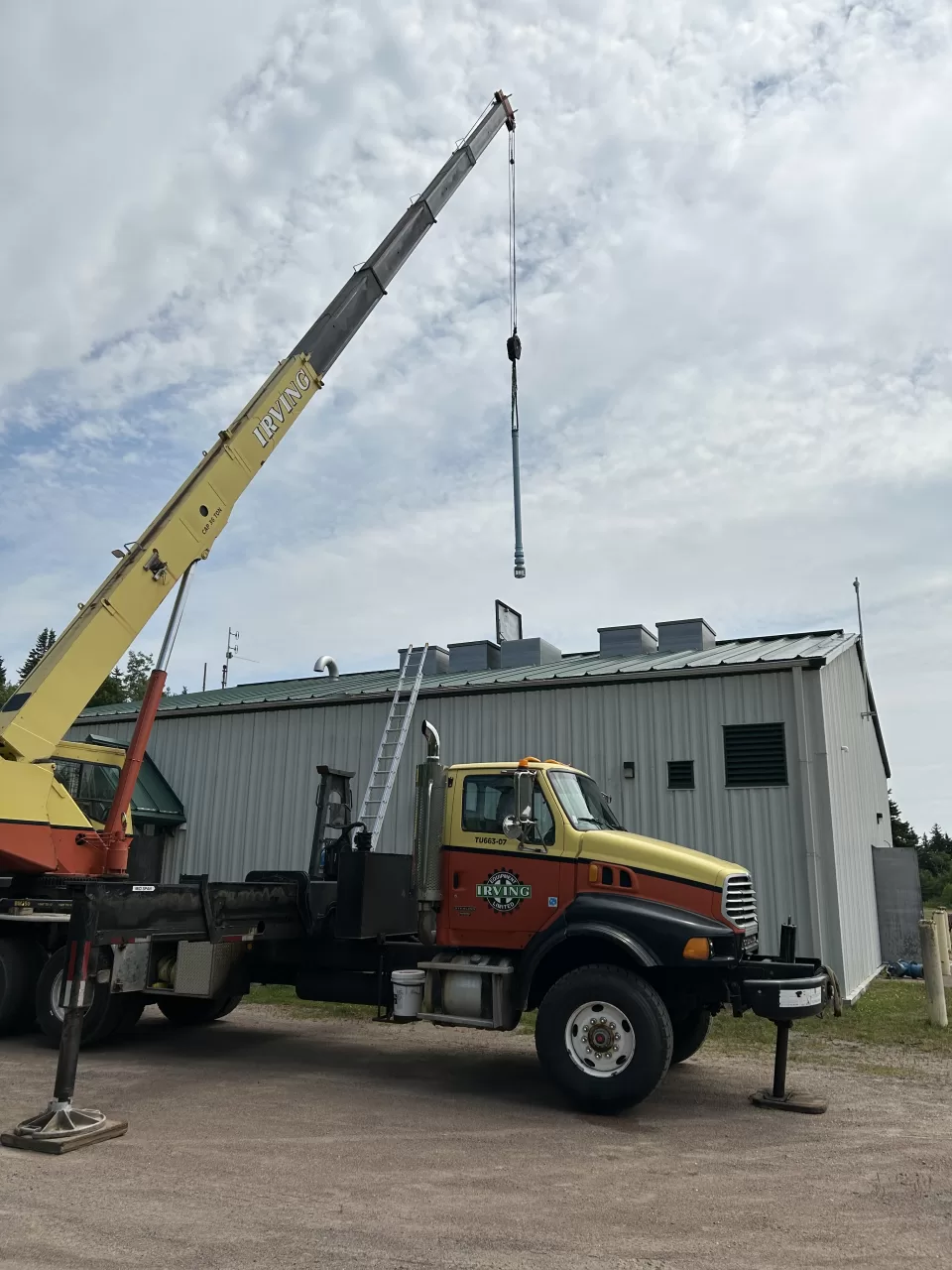
Sackville’s water supply has been “limping along” recently, dealing with three underperforming low-lift pumps in the town’s water treatment plant. But that changed last Thursday, as contractors replaced one of the three pumps that help push raw water into the town’s filtration system.
“We’ve had to manage what we’re doing with water supply,” says public works director Jon Eppell, noting that things like the refilling of the Mount Allison pool and the annual watermain flushing program have been pushed back to allow for the new pump replacement. “We’ve been a little bit vulnerable,” says Eppell, “but because we’ve been monitoring and taking these other steps, we’ve been okay.”
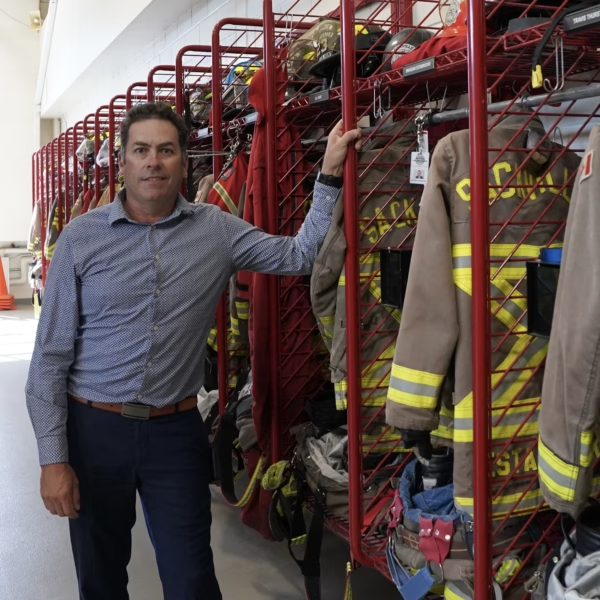
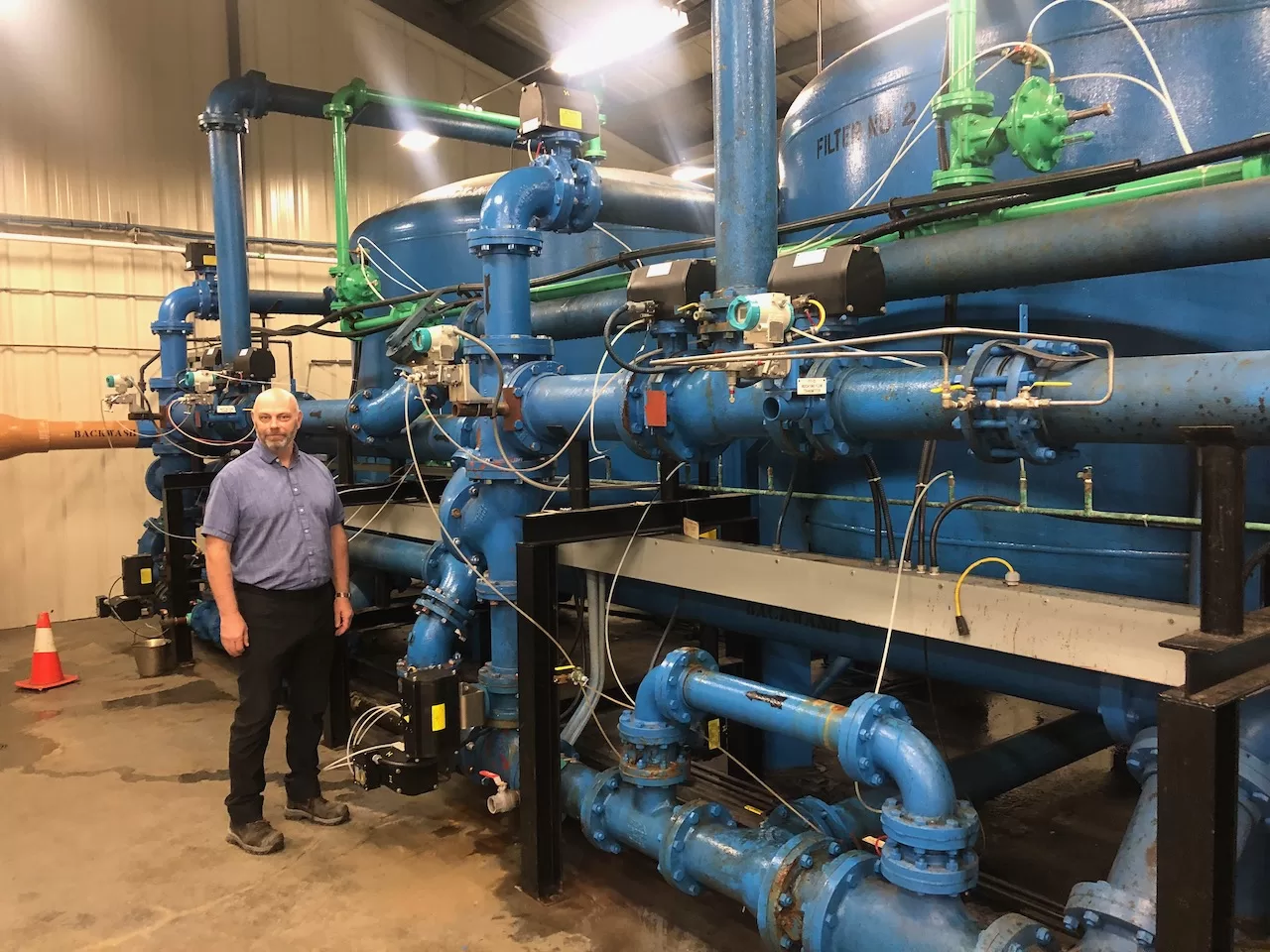
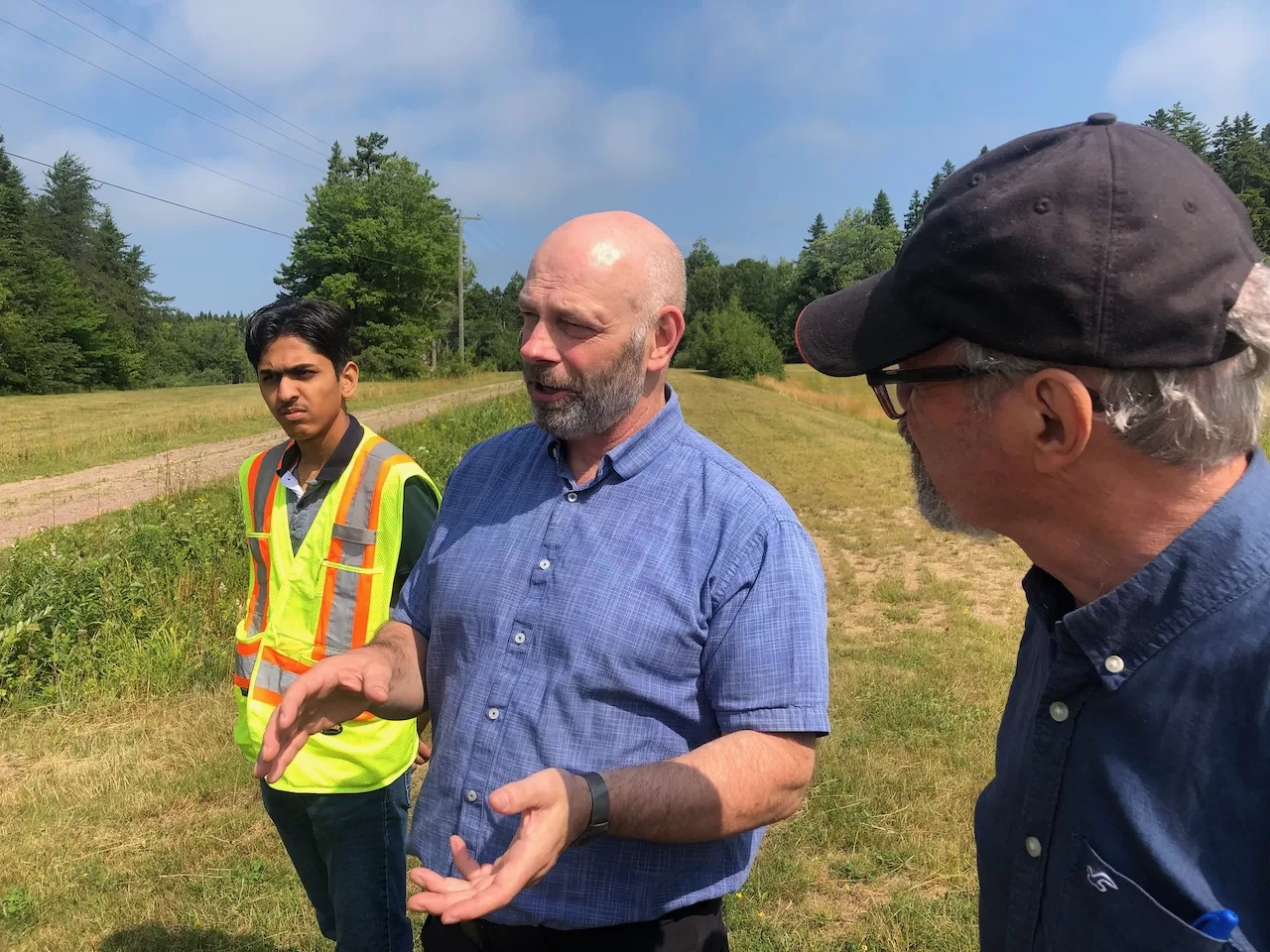
Eppell and Veolia manager Ron Nicholson took reporters on a tour of Sackville’s water treatment plant last week.
The older low lift pump (which has been in use without any refurbishment since 1997) will be taken out of the building through a hatch in the roof designed especially for that purpose. And then a new low lift pump, which cost the Sackville water utility about $60,000, will be lowered in through the same hatch, and assembled upright inside the building.
Tantramar has opted to refurbish the removed pump, and then replace the next older low lift pump, which will be refurbished in turn. The whole installation and refurbishment plan will cost about $100,000, and at the end the water plant will have one new and two refurbished low lift pumps in operation, and one refurbished pump in reserve.
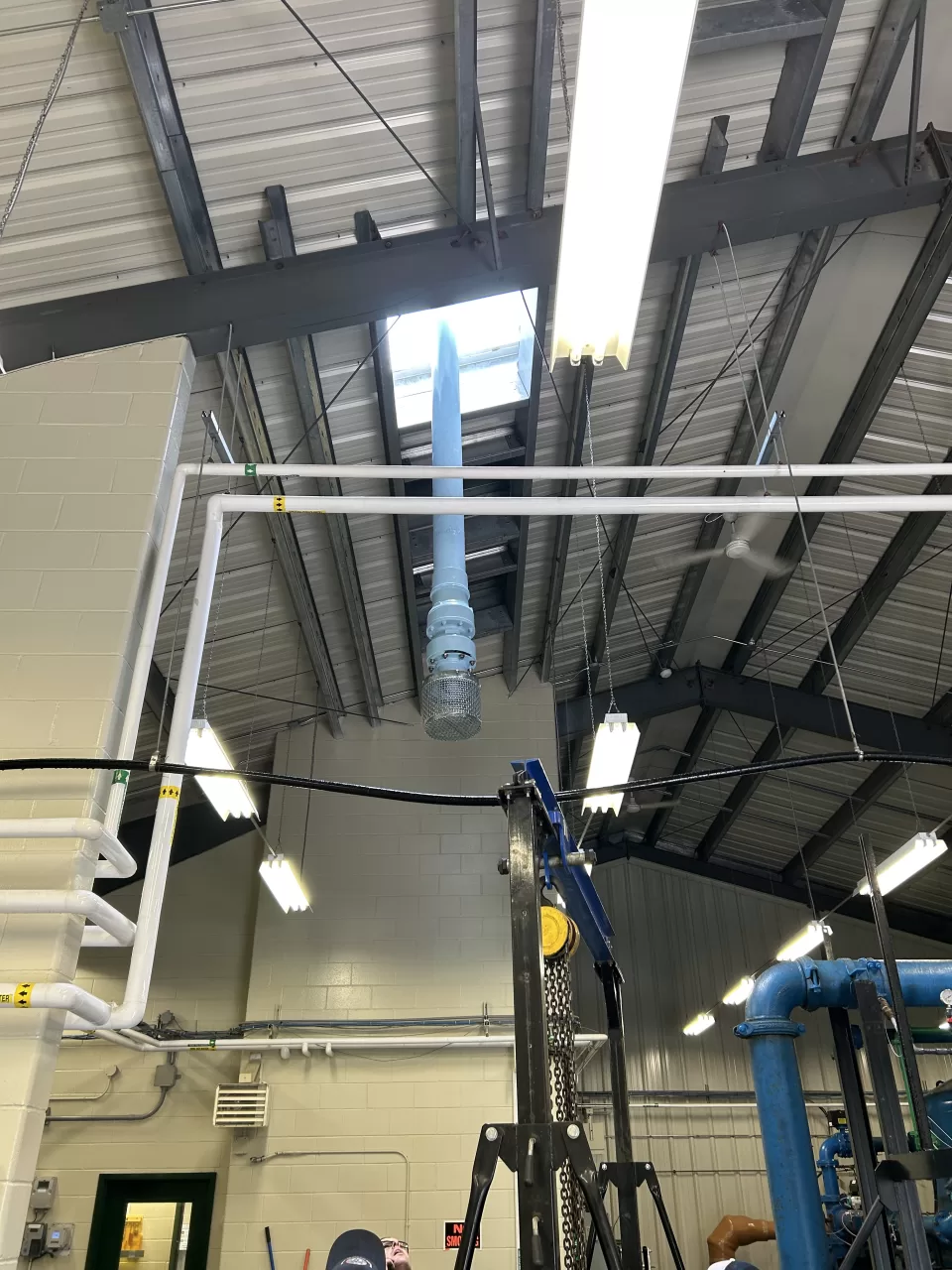
Sackville’s water treatment plant produces about 2500 cubic meters of clean drinking water a day, to a higher standard than even some bottled water, says Eppell. That’s about the same amount as one Olympic sized swimming pool.
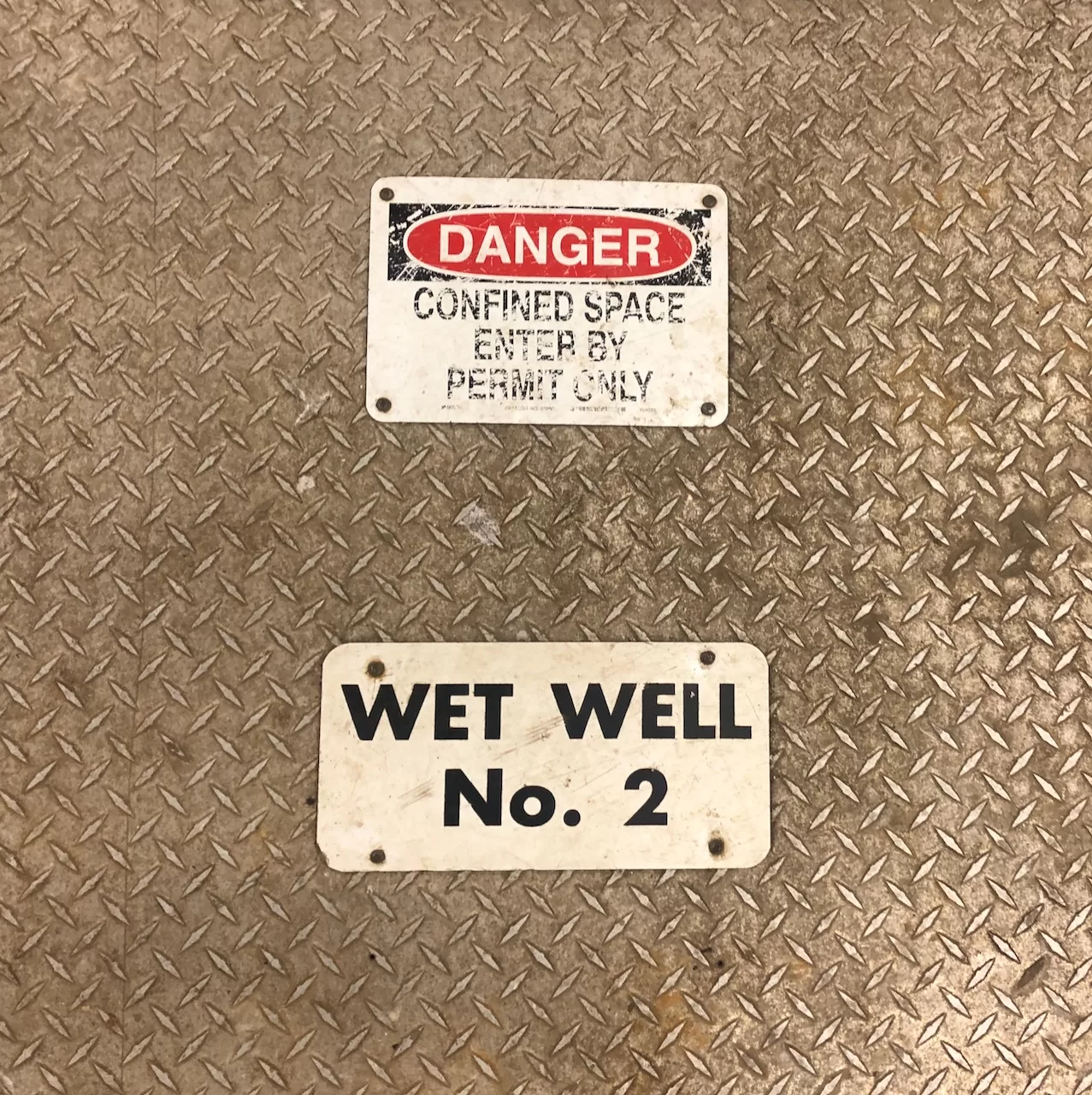
That water starts its journey being pumped from one of three different wells scattered around the plant off Walker Road, near the Ogden Loop trails, and then into a “wet well” reservoir underneath the treatment plant building.
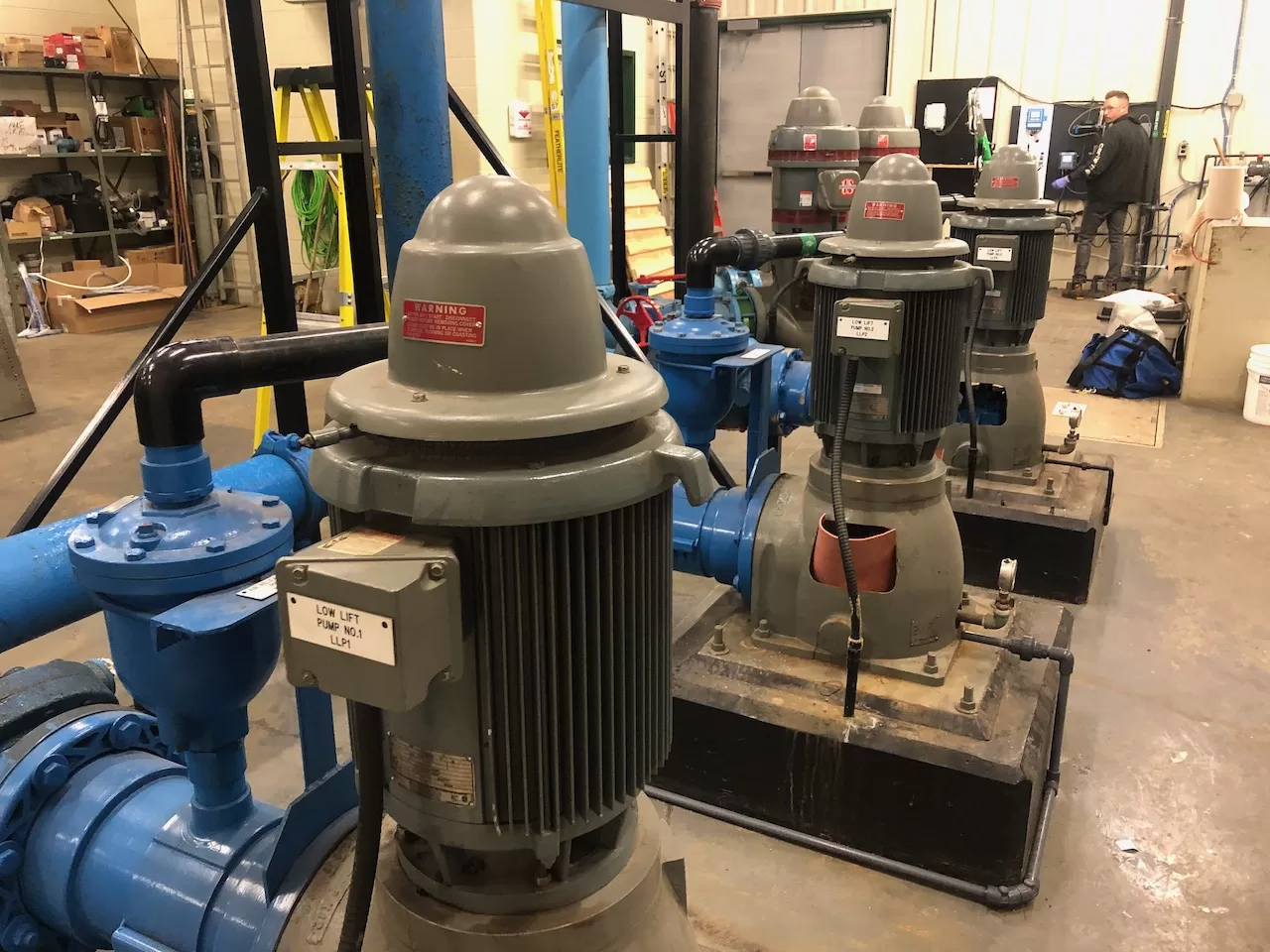
That’s where the low lift pumps come in. They pump water up and into two large blue tanks containing sand and anthracite to filter out things like high levels of manganese and iron which are found in Sackville’s raw well water.
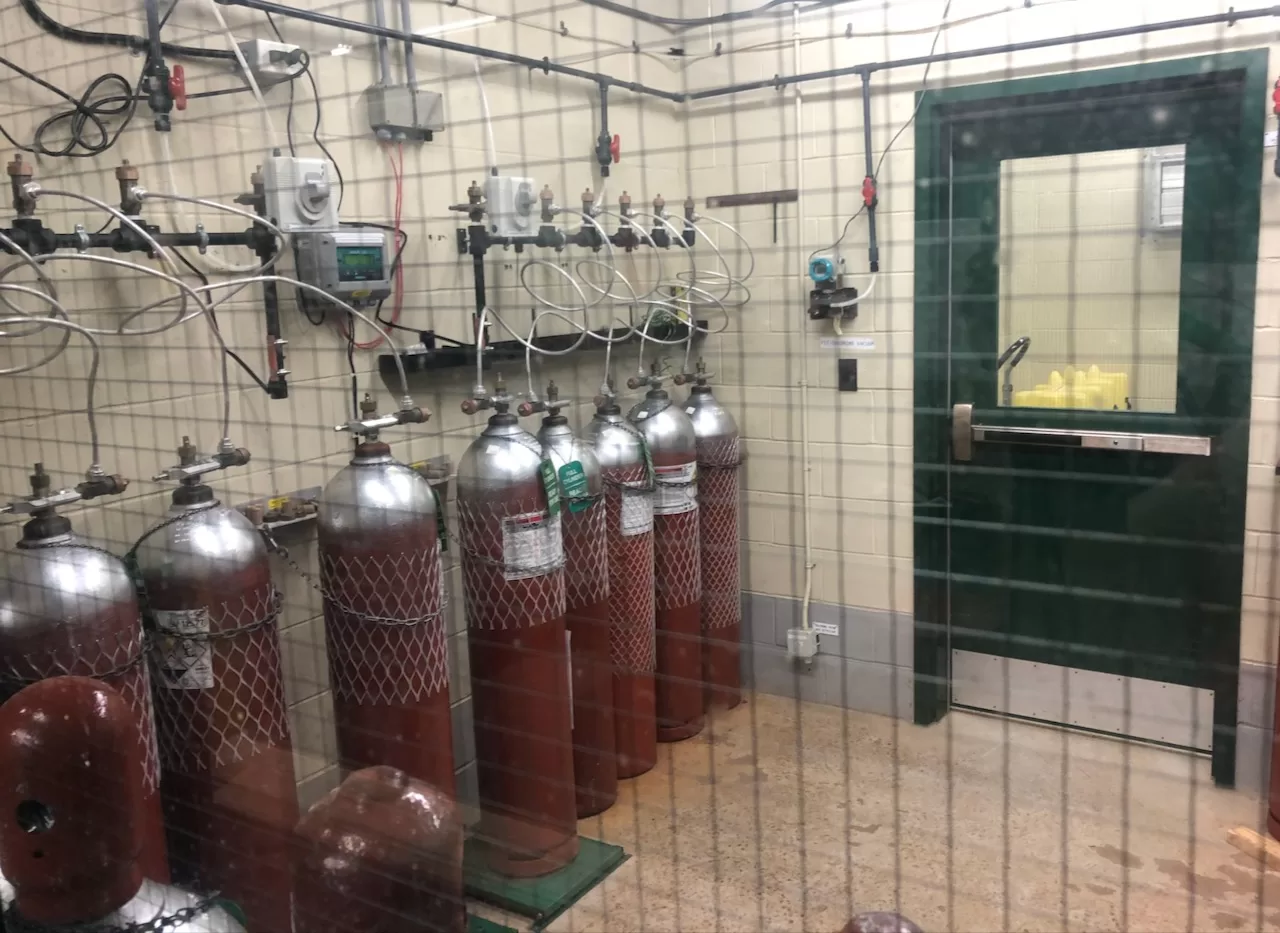
The filtered water then goes into another, larger tank underground, and that’s where chlorine, caustic soda and polyphosphate are added. The soda helps balance the pH level of the water, and the polyphosphate helps prevent leaks in the distributing system.
Nicholson says caustic soda makes the water more palatable and easier on skin. “Once it went in, the complaints from the town went way down,” says Nicholson.
Nicholson and his team from Veolia are contracted by Tantramar to run both the Sackville and Dorchester water plants. The company also runs the much larger Moncton treatment plant, their anchor client in the region, which treats about 45,000 cubic metres each day, says Nicholson. Moncton’s treatment system is not just bigger, it’s also more complex, with water coming from a reservoir. That’s something that used to be the case for Sackville.
“The reservoirs were originally the water supply,” says Eppell, but now serve as a backup only. “If we ever had to use them, they are there,” says Eppell, but “we fully expect it would require a full boil water order for the town if we had to go to the reservoirs.” But that’s unlikely to happen from lack of raw water supply.
“We now use three relatively deep wells,” says Eppell, “basically in three different quadrants. They’re trying to pick up different aquifers so that we don’t exhaust a layer of water that’s in the ground.”
“The advantage of using wells is that there’s some natural filtering that happens, and you’re less susceptible to surface runoff and feces from animals and air pollution and that sort of thing,” says Eppell. Sackville’s wells are also in a wellfield protection zone which prohibits certain activities, he says.
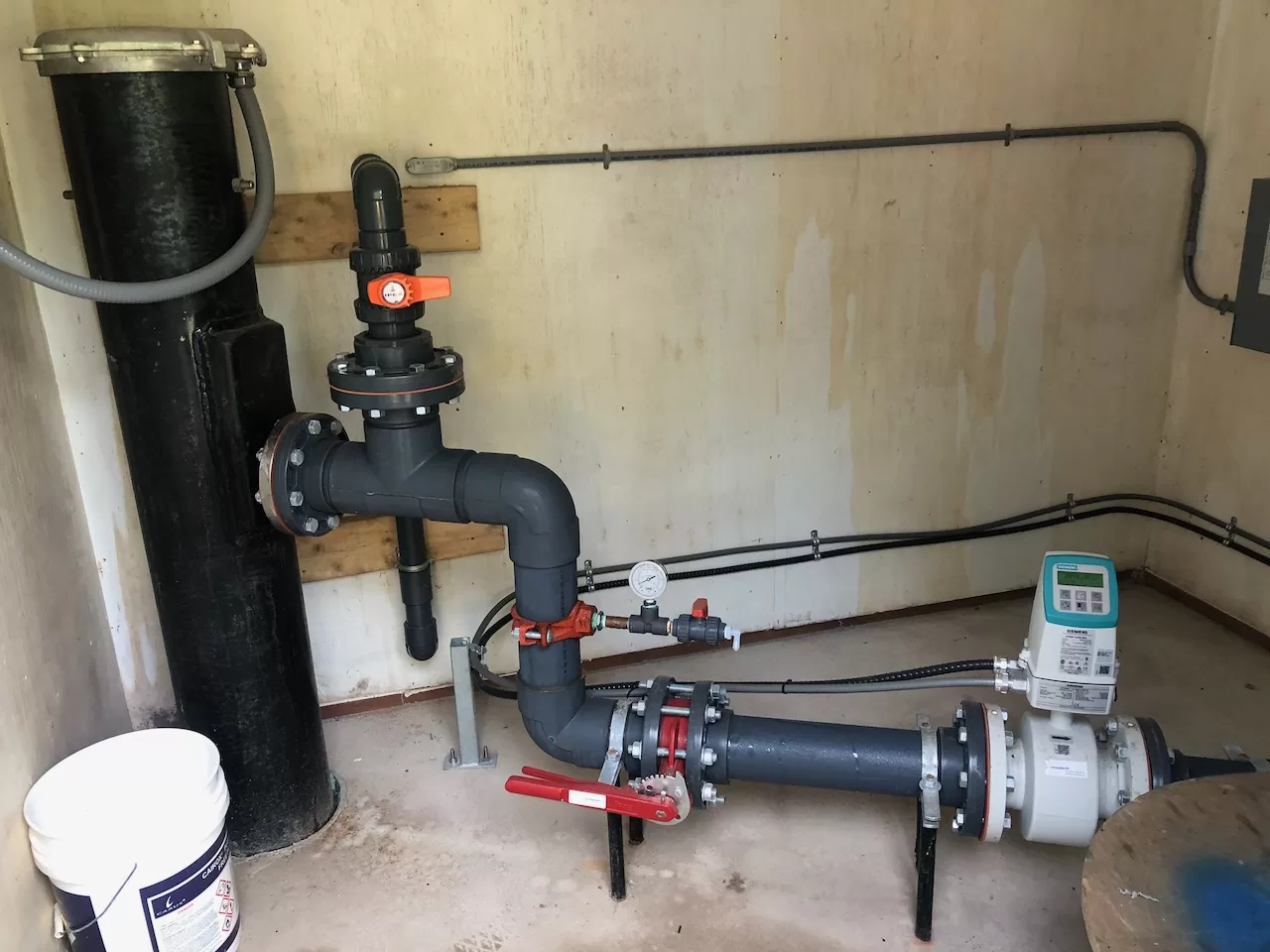
The iron, manganese and other particles that get filtered out of Sackville’s water end up in one of two contained ponds nearby the water treatment plant. Inside the plant every day, a backwash system blasts some clean water back through the large filtration tanks, to remove whatever has been filtered out of the raw water. That backwash ends up in one of two contained settling ponds on site, and every few years, the ponds are dredged with material piled and compressed on site, says Eppell.
Every 15 years or so the sand in the two large filtration tanks needs to be replaced, which Nicholson says is a big job that requires taking one of the tanks offline, something that gets done overnight or during low demand times. That means avoiding summertime, and the fall, when Mount Allison students return to campus.
Redundancy is a recurring theme in water treatment. The Sackville plant has three wells, each with their own pump. Then there’s three pumps lifting water into two filtration tanks, and two backwash pumps to clean them. Whenever something needs to come offline for maintenance—like last week when a new low lift pump was installed—the system as a whole still works.
“We can run off one well, but we don’t want to exhaust the aquifer,” says Eppell. “We could probably manage on two wells and not exhaust either aquifer, but we have three, so that we’ve got more redundancy. We’ve got more security of the water supply, in the hopes that we never would have to go to the reservoir.”
“It’s always good to have a belt and britches approach,” says Eppell. With three wells as the belt, and a reservoir as the britches. “So when an absolutely everything else is gone non-operational for whatever reason, we have some way of supplying water, if for nothing else, for fire protection.”
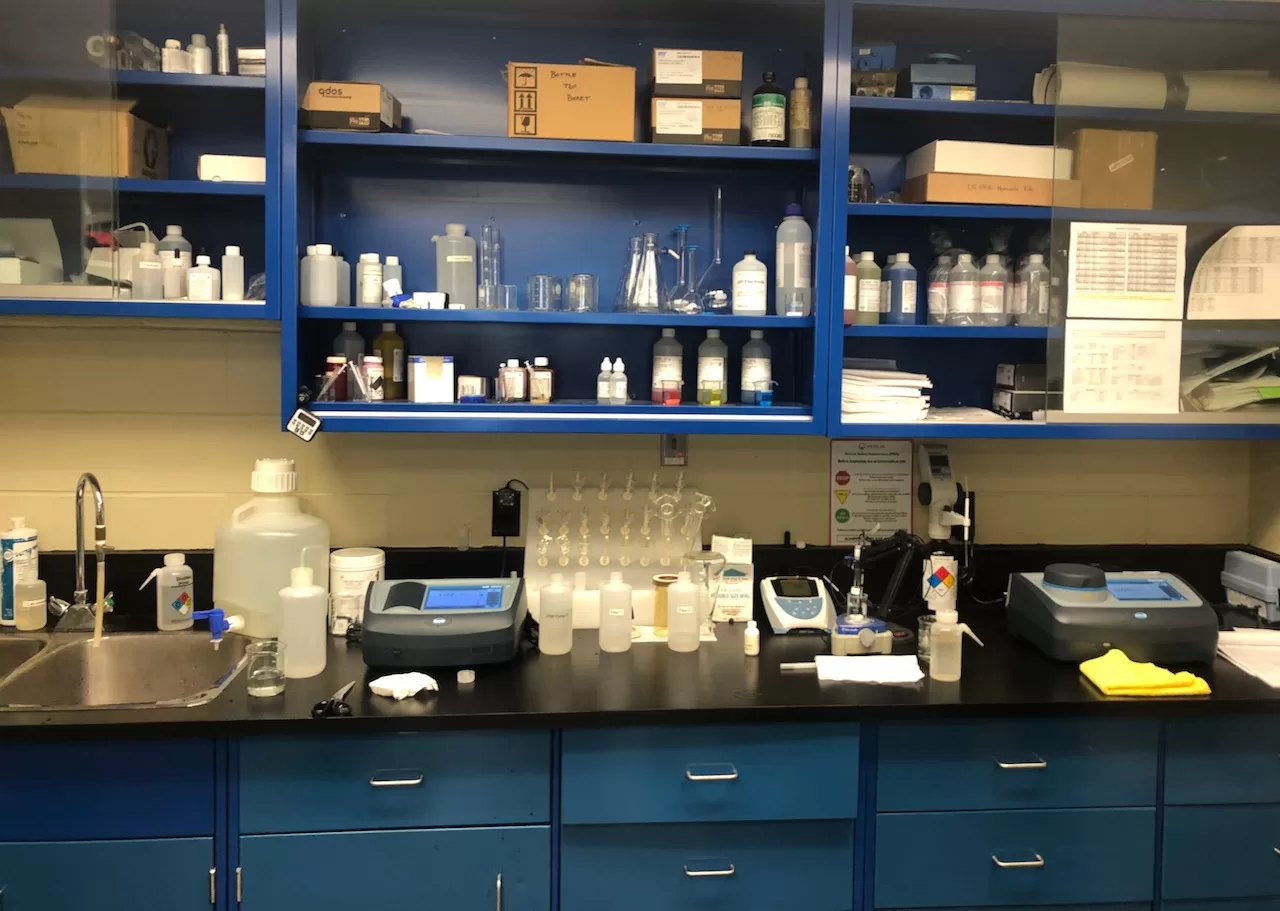
The treatment plant also has a small water testing lab that serves two main functions. First, Veolia staff test the treated water twice a week to make sure it meets Canadian drinking water guidelines. Second, staff run regular tests to make sure that the automatic analyzers that are throughout the system are accurate.
“Obviously we’re not here to test the water every minute, every second of the day,” says Nicholson. “We have to trust those analyzers.” And so workers test for accuracy in various readings throughout the process, in addition to testing the final water product that leaves the plant.
Eppell adds that public works staff also do testing throughout the distribution system.
Nicholson says Veolia staff are on site in Sackville and Dorchester at least twice per week on the regular, and more often to conduct any additional maintenance procedures. Veolia staff also have access to the system through a SCADA (Supervisory Control And Data Acquisition) system, which is essentially a complex remote control app. Veolia operators “will make adjustments in [the remote system] if they’re not here on site,” says Nicholson. The system can trigger phone calls is alarms aren’t answered. “Usually if it gets to me, it’s not going any further,” says Nicholson. “It’s really monitored 24/7,” with operators able to either make adjustments remotely, or come to the plant to physically respond.