
(NB-Stimulant-Study)
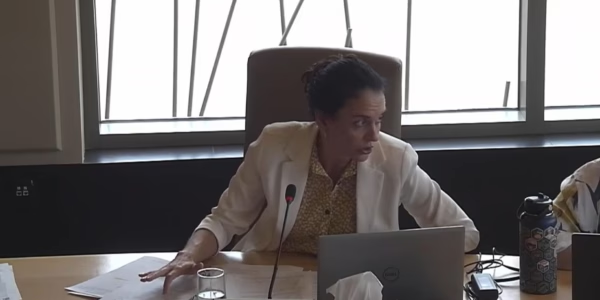
A Fredericton clinic is part of a national trial looking at treatments for crystal meth addiction.
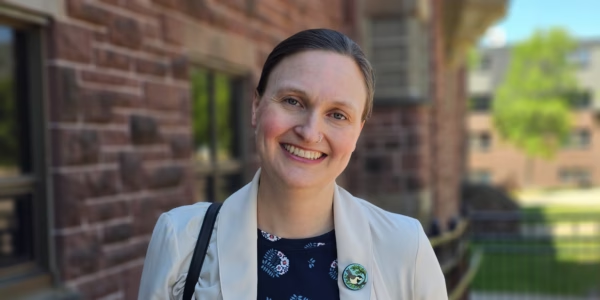
Dr. Sara Davidson with the River Stone Recovery Centre says the clinic was already prescribing some experimental treatments when it was asked to take part.
She told C-B-C News that her team had some good results and they were now trying to document how well their methods stand up to scientific scrutiny.
She says five medical sites across the country are involved in the study, which is being billed as the largest-ever clinical trial for methamphetamine use disorder.
(CBC News)
——–
(NB-Teen-Dead)
A 17-year-old boy is dead after a car and an all-terrain vehicle crashed in Tide Head, New Brunswick.
R-C-M-P believe yesterday’s crash happened when the A-T-V overtook a car travelling eastbound, and then collided with an oncoming vehicle.
Police say the driver and only person on the A-T-V died at the scene.
The driver and two passengers of the car didn’t sustain injuries.
(The Canadian Press)
——-
(NB-Nursing-Home)
A 60-bed nursing home will be built in Champdoré, New Brunswick.
The government says the home will bring more long-term care options to the southeastern part of the province and add more nursing home beds to the long-term care network.
The home is expected to open in 2026.
Comfort Life Network already operates several nursing homes across the province and it’s now tasked with building and operating the new one in Champdoré.
(The Canadian Press)
—
(NS-LGBTQ-Hate)
Nova Scotia’s human rights watchdog is urging all Nova Scotians to speak out to defend the rights of L-G-B-T-Q-+ people.
The province’s human rights commission says it is “deeply concerned” about increasing levels of hate toward the L-G-B-T-Q-+ community in the province and across the country.
The watchdog points to a recent poll by Paris-based research firm Ipsos that says Canada showed some of the sharpest drops in support for queer and transgender people among 23 countries profiled.
The commission says the province’s Human Rights Act forbids any differential treatment based on sex, sexual orientation, gender identity and gender expression.
(The Canadian Press)
—
(NB-Parkinson’s-Treatment)
A new program at a New Brunswick hospital is expected to provide an innovative treatment for patients with Parkinson’s disease.
The New Brunswick government says deep brain stimulation, which is a surgical treatment involving implanting a device into the brain, will be available at the Moncton Hospital.
The device, sometimes known as a pacemaker for the brain, sends electrical impulses to specific areas of the brain that can alleviate symptoms for some neurological disorders.
The province is spending 394-thousand dollars in annual operational funding and the 250-thousand dollar equipment for the procedure was donated through the Friends of the Moncton Hospital Foundation.
(The Canadian Press)
—
(PEI-Wind-Farm)
The second phase of repairs has begun on the wind farm in Hermanville, near the eastern tip of P-E-I.
The province says five turbines were fixed last year and are now working well.
It says a crane is set up to begin work on a sixth turbine, and it will move on to two more before all of the work is finished at the end of August.
The P-E-I government says the Hermanville Wind Farm has generated a surplus of 21.8-million dollars as of March 31st, 2024, and it has provided Islanders with more than 881-thousand Megawatt-hours of energy.
(The Canadian Press)
—
(NL-Private-Shelters)
The mother of a woman who died in a for-profit shelter in St. John’s, Newfoundland says her daughter lived there in fear, and desperately wanted out.
Joan Dunphy says her daughter, Rayna Dove, kept detailed notes in her journals about how unsafe she felt at the shelter before she was killed there on December 27th, 2021.
Six pages of complaints filed about the province’s for-profit shelters between November 1st and April 1st show many residents still feel unsafe and in danger while staying at these facilities.
Housing Minister Fred Hutton says the province is aiming to stop using private shelters that don’t offer services such as counselling and addiction support.
(The Canadian Press)
—