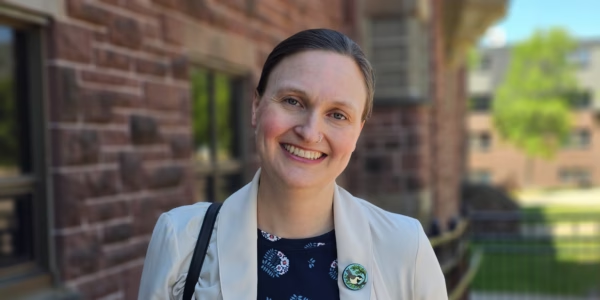

Phaedra Williams just finished her second year of university, and the young Mount Allison political science student went out with a bang.
Williams won the Atlantic Provinces Political Studies Larry Collins Prize–awarded each year to the best undergraduate essay written by a student attending a university in Atlantic Canada.
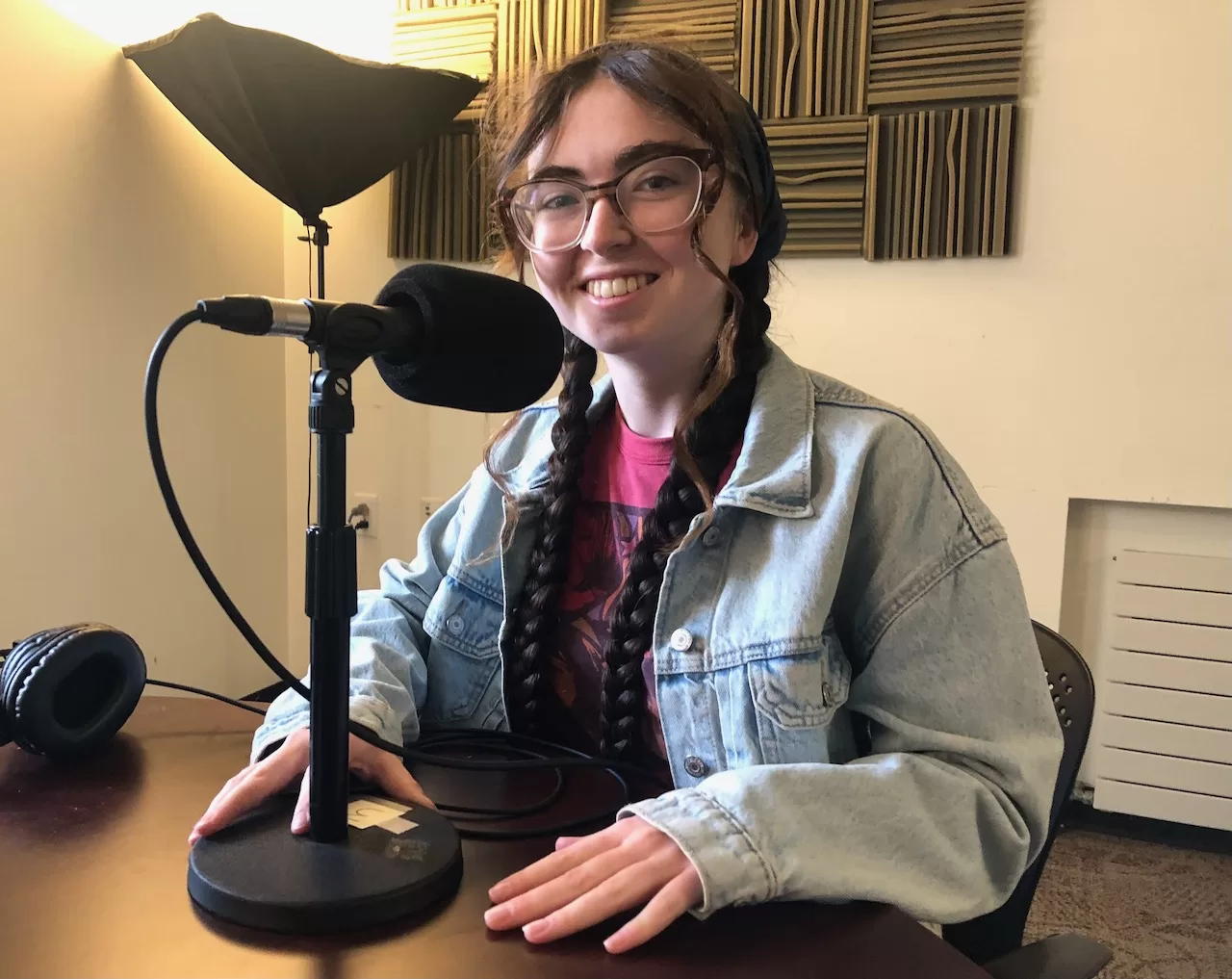
Williams, who has lived most of her life in Midgic and also has roots in Dorchester, stopped by CHMA studios to tell us about it.
Williams’ winning essay focussed on Policy 713, the provincial education policy which aimed to protect the rights of trans kids in public schools. Williams analyzed the controversy around the policy created when the PC Higgs government moved to strip the policy of some of its protections, and then the eventual return of some protections by the Liberal Holt government.
Williams says her interest in the politics around Policy 713 started from a personal place. “I’m a queer person myself. I’m not trans, but I have a lot of trans friends,” says Williams. “And so I know that Policy 713 was hugely detrimental, and was a huge kind of crisis point in New Brunswick.”
Williams says that one of the reasons she wanted to look more closely at what happened with Policy 713 is to help create awareness of what she calls anti-trans policies in Canada.
“We’re at a point in time where there’s so much change happening in terms of left wing and right wing politics, specifically with transgender people,” says Williams, “so I wanted to kind of bring attention back to that and really focus and say, like in Canada, we do have these anti-trans policies. It’s not just a United States thing. It’s not just like a UK thing… It’s here, it’s happened.”
In her essay, Williams looks at the forces at work behind the politicization of Policy 713, such as the radicalizing effects of COVID-19 pandemic policies, and the Trump phenomenon south of the border. When Policy 713 first came under scrutiny from the Higgs government, Trump was building momentum in the US towards a second presidential term.
“As people in the United States kind of started to get very radicalized, and the Trumpian support was really reaching its peaks, in Canada we saw a lot of very similar kind of nationalist movements, a lot of right wing movements,” says Williams.
“Trans people are often targeted,” says Williams, “because it’s a demographic that people aren’t very familiar with. And so they’re the first ones to be kind of targeted by right wing, radical conservative ideology.”
Ultimately the Higgs government was not re-elected in the fall of 2024, something which Williams says was due in part to opposition to his actions on Policy 713.
“We were very lucky to have such backlash against it, and that that backlash turned into voter turnout,” says Williams.
The new Liberal majority government returned many of the protections of the original Policy 713, such as the right to washrooms and extra-curricular activities, says Williams. But there’s one part of the Liberal policy that remains problematic for the political science student. The policy allows for “rare cases” where school personnel have concerns about the capacity of a student to determine their gender identity.
Williams finds it an “odd kind of policy choice to me, because the document starts with saying students are presumed to have the ability to understand their identity. That’s their business.” She says the “rare cases” caveat relies on “conservative rhetoric that being trans isn’t an identity.”
“And, you know, for some people, their gender identity absolutely does kind of oscillate… It does change throughout their life, but that’s very different from saying a student doesn’t have the capacity to understand their identity,” says Williams.
Williams’ essay was born out of a seminar class in Advanced Public Policy with political science professor Dr. Mario Levesque, who encouraged her to submit her paper for the Larry Collins Prize. “It’s really nice to have a professor believe in your work to that extent,” says Williams, who plans to pursue an honours degree in political science at Mount Allison before moving on to a master’s program elsewhere in Canada.
And Williams is not ruling out an active role in politics one day. “I’ve really enjoyed doing research,” says Williams. “But I also think that being right in the middle of the political arena, I think that you have a lot of opportunity to create change there, which is something that I’m really interested in.”
“I want to help as many people as I can,” says Williams. “I want to be a voice for, you know, the queer community and the rural community.”