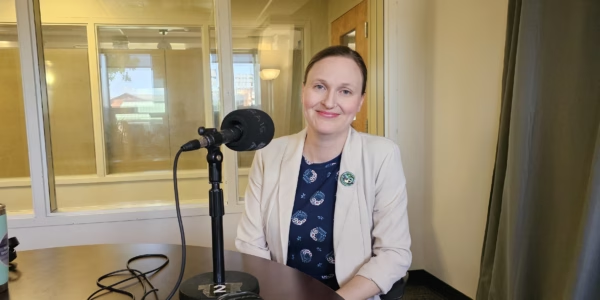

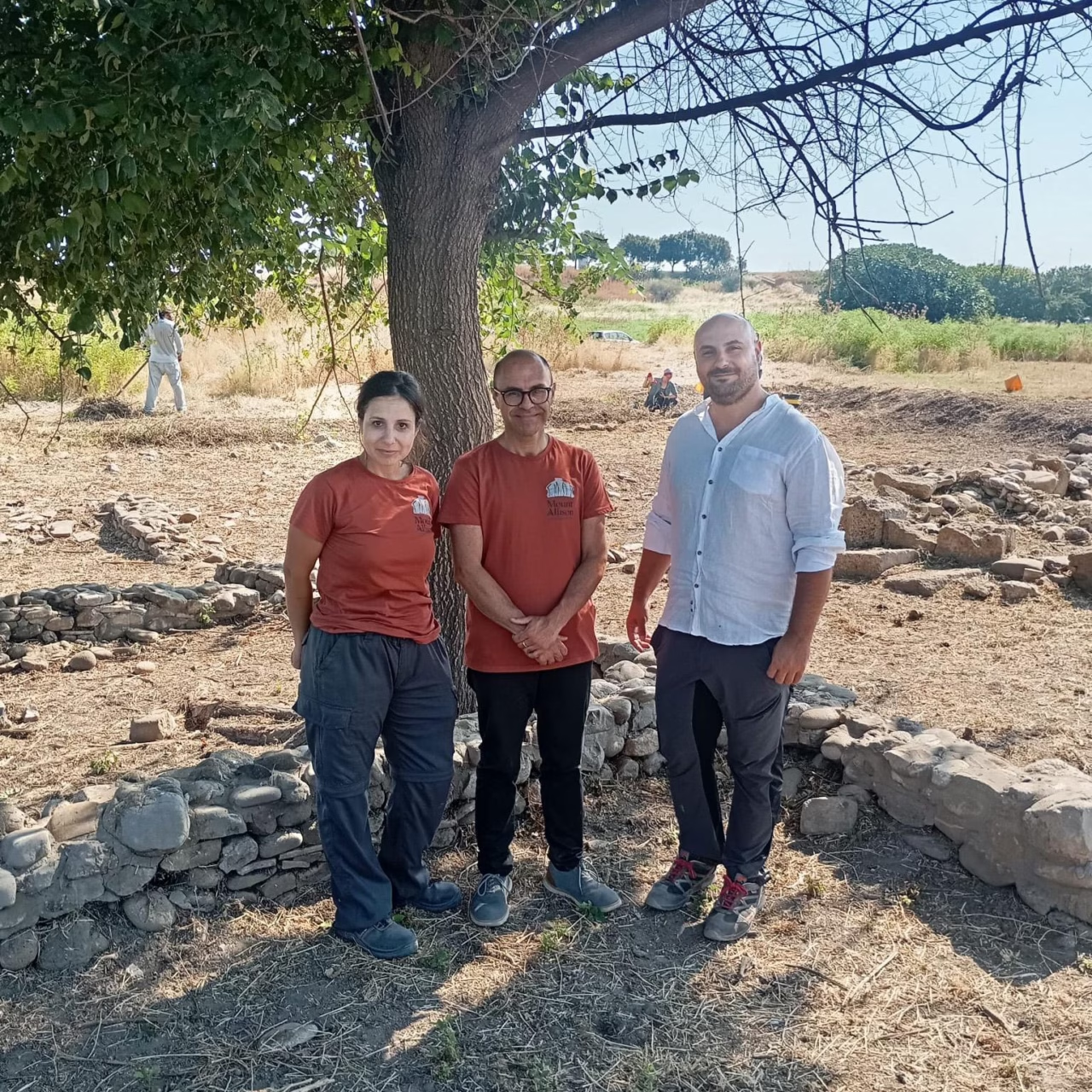
For Ilaria Battiloro, archaeology is more than just history. It’s a way to give voice to the voiceless, like the Indigenous populations of southern Italy she has spent much of her career studying, who have no written sources of their own, but who feature in various Greek and Roman sources.
“ So we have to interrogate the objects. We have to ask the material culture they have left to us to, again, reconstruct who they were, how they lived, and how they interacted with the Greeks first and the Romans later.”
In reconstructing those interactions, she hopes to shed light on how cultures influence one another today.
Over the summer, the Mount Allison professor—in both the department of classics and visual and material cultural studies—had the opportunity to expand Mount Allison’s archaeological efforts in Italy and further explore the relationship and exchanges between ancient cultures.
Listen to the audio below:
Battiloro was approached by the director general of museums at the Italian Ministry of Culture to develop a new research project at the site of the ancient city of Herakleia. Out of that came the Sacred Herakleia Project, an international collaboration with Mount Allison, archaeologist Mattia D’Acri, and the National Archaeological Museum of the Siritide, part of the Italian Ministry of Culture.
”This is a very exceptional opportunity for Mount Allison because, for this project, Mount Allison is involved in an international research project in one of the main Greek cities of southern Italy,” Battiloro said. “There are other very important—illustrious, I would say—research teams already working there, including the University of Berlin and the University of Basilicata.”
The site
Herakleia was a Greek city, founded in the mid-fifth century BCE. For Battiloro and her team—which included a few Mount Allison students—the site is especially significant due to its association with an even older Greek settlement Siris, said Battiloro.
”Of course, they didn’t arrive in an empty landscape. This area was, in fact, inhabited (and) had been inhabited for centuries by indigenous people. So I am very much interested in reconstructing (and) contributing to reconstruct how these encounters worked.”
Though Herakleia is a well-known archaeological area, the location they are looking at is a lesser-studied religious sanctuary, the Sanctuary of Vallo. Originally discovered in the 1960s, it has only been sporadically investigated since. So many questions remain, like how it developed or even which deity or deities were worshipped there.
Among the first exciting discoveries were new architectural remains, found when they expanded the excavation area.
They also enlisted geologists to collect sediment samples to help with reconstructing the paleochannel, or ancient riverbed. While a brook exists today, when the results come back, the samples will tell them if it also existed in antiquity, where it may have served as a natural border for the sanctuary, said Batilloro.
“ Water is important for ancient religion because water is obviously associated to concepts of fertility, fecundity, but also purification.”
End of the season
While this year was a pilot season, Battiloro said it was an extremely productive one, with the new archaeological evidence from the expanded excavation, and more questions to research next year.
Thanks to the success, Battiloro said the plan is to expand the project to a full archaeological field school, with between 15-20 students participating each year, which will provide plenty of educational opportunities for students at Mount Allison, she said.
“ For Mount Allison students specifically, it means moving from studying the ancient Mediterranean in class here in New Brunswick to actually participating in the process of discovering an archaeological site in the ancient Mediterranean and understanding it within the broader context of the Mediterranean Basin.”